
Arm knitting yarn that holds shape and feels good
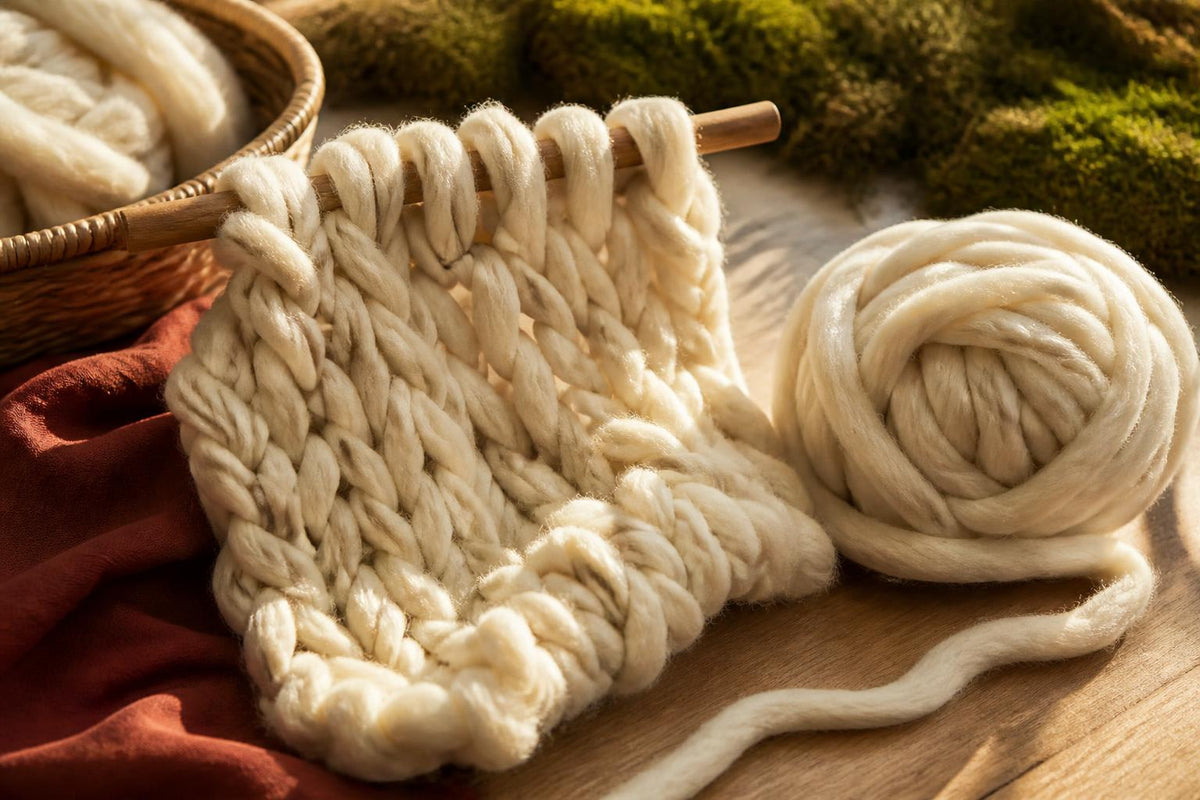
Arm knitting works best with yarn that is genuinely thick, softly structured, and able to grip itself just enough to stop the fabric sliding open. If the yarn is too thin, too slippery, or too loosely made, the stitches spread, the shape drops out, and the finished piece can feel more like netting than knitwear. For most people, that means looking at properly substantial fibres rather than trying to force an ordinary knitting yarn to behave on the arms.
When people ask us about chunky wool for arm knitting, the real question is usually twofold. Will it hold its shape, and will it still feel pleasant once the project is finished? Those two things depend on the same practical details, thickness, fibre, twist, softness, and consistency across the skeins you buy. If you understand those, it becomes much easier to choose well and to estimate how much yarn you need before you cast on.
What makes a yarn suitable for arm knitting
Arm knitting creates very large stitches. That changes what matters in a yarn.
With needle knitting, a yarn can rely on the needle size and the tighter control of the hands to keep the fabric even. With arm knitting, your forearms become the “needles”, so every stitch is larger, more exposed, and more likely to show weakness in the yarn. A suitable yarn therefore needs enough bulk to fill the stitch, enough cohesion to stay intact, and enough softness to remain comfortable in a finished blanket, cowl, or cushion cover.
Thickness is the first point. A true super chunky yarn is usually the most practical starting point for arm knitting. If the yarn is lighter than that, you often need to double or treble strands, which can work, but changes the handle and can make the stitches split or twist. A single, substantial strand is easier to control and gives a cleaner look.
Structure matters just as much as thickness. Some very bulky yarns are tightly spun, while others are more like roving, with less twist holding the fibres together. A low-twist yarn can feel beautifully soft and lofty, but it may also pill, shed, or thin out in places if handled roughly. A more structured yarn tends to define the stitches better and stand up to repeated use. For arm knitting, there is a balance to strike. Too firm, and the project can feel stiff. Too loose, and the fabric may sag or wear quickly.
Softness is not just a luxury. In large-scale stitches, the surface of the yarn is especially noticeable. A blanket knitted on the arms sits directly against skin, often over a large area, so prickliness becomes obvious very quickly. That is one reason merino is such a common choice for oversized projects. It combines softness with enough body to make the stitches visible and tactile without feeling harsh.
Grip is the point many beginners overlook. A yarn with a little natural friction helps each loop stay where you put it. If the fibre is very smooth or slick, the stitches can lengthen under their own weight before you have even cast off. Wool usually offers more grip than many synthetic fibres, and that can make the whole process calmer and more predictable.
If you are comparing options, it helps to think in terms of behaviour rather than labels alone. “Bulky” or “super bulky” can vary between brands and countries. Looking at the yarn itself, and at the finished stitch definition, tells you more. We cover the broader decision-making process in our guide to choosing wool for hand knitting with confidence, but for arm knitting specifically, the safest route is a yarn that is thick, even, soft, and resilient.
Our own retail range includes super chunky merino yarn for oversized knitting projects, including World of Wool Chubbs. That combination of super chunky scale and merino softness is exactly why this type of yarn is so often chosen for arm-knitted pieces.
How super chunky merino compares with other options
Super chunky merino is often the benchmark people have in mind when they picture arm knitting. It is soft, springy, and visually generous. The fibres trap air well, which gives warmth without making the fabric feel hard or flat. In big stitches, that loft helps the project look full rather than stringy.
Compared with ordinary wool yarns in lighter weights, super chunky merino reaches the right scale much more easily. You do not have to hold several strands together or work a huge number of rows to get visible progress. That matters because arm knitting is often chosen for its speed and for the sculptural look of the stitches. A finer yarn can still be beautiful, but it generally suits needle knitting or smaller-gauge work better.
Compared with acrylic super chunky yarns, merino usually feels more breathable and less squeaky in the hands. It also tends to have a more natural bounce, which helps the stitches recover. Acrylic can be useful where easy-care washing is the top priority, but some versions are very smooth, and in arm knitting that can mean less grip and more slippage. The finished fabric may also feel less cushioned than a good wool-rich alternative.
Compared with cotton, merino is lighter for the same visual volume. Cotton has its place, especially in structured homeware or warmer-weather makes, but it is denser and has less elasticity. In arm knitting, that extra weight can pull stitches longer over time, especially in a blanket. If you are curious about how cotton behaves in knitted fabric more generally, our article on choosing cotton wool for knitting without costly mistakes sets out the trade-offs clearly.
Compared with alpaca-rich yarns, merino often gives better stitch memory. Alpaca is wonderfully soft and warm, but it can drape more and spring back less. For some scarves and wraps that is ideal. For arm-knitted pieces that need to keep a bolder outline, merino is often easier to manage.
Compared with loosely drafted unspun roving, super chunky merino yarn with a more stable construction usually wears better. Pure roving can create a dramatic, cloud-like look, but it is more vulnerable to thinning, matting, and surface wear. That is worth bearing in mind if the project will be used every day rather than styled occasionally.
Within the broad category of super chunky fibres, construction still matters. World of Wool Chubbs sits in the area many knitters want for arm knitting, substantial enough to make the scale work, and soft enough to feel inviting in the finished piece. If you are weighing up categories before choosing, our guide to super chunky wool yarn for UK projects is a useful next step.
One terminology point is worth mentioning. If you use patterns written abroad, especially from the US, yarn weight names and crochet terms can shift. The same applies to stitch names in patterns, where UK crochet terms and US crochet terms differ. For arm knitting this matters less than it does in crochet, but if you are adapting a mixed craft pattern or reading project notes, always check the language convention before you buy yarn.
How much yarn you are likely to need
The most accurate way to estimate yarn for arm knitting is not by copying someone else’s blanket recipe. It is by measuring your own stitches.
A tension square is the best tool for this. Even with oversized knitting, the principle is the same as in ordinary garment knitting. Make a sample, measure it, and use that information to calculate the full project. Because arm knitting relies on your body position, arm width, and how tightly you naturally hold the loops, two people can use the same yarn and get very different results.
For an arm-knitted tension square, cast on enough stitches to create a sample at least 30 cm wide if possible. Work for enough rows to form a square shape, then lay it flat without stretching it. Measure the width and height of a central area, not the curled or uneven edges. Count how many stitches and rows sit within that measured area.
Then ask three practical questions.
First, what size will the finished item be?
A lap blanket, a throw, a baby blanket, and a bed runner all have very different yarn demands. Measure the intended width and length in centimetres. If the item is meant to drape over furniture, include the drop. If it is wearable, measure around the body area it needs to cover rather than guessing from a photo.
Second, what stitch style are you using?
A simple stockinette-style arm knitting fabric usually uses less yarn than a heavily textured stitch. Open stitches use less than dense stitches. Rib-like structures can draw in and use more length than they appear to. If you are adapting from a needle pattern, do not assume the original yardage transfers neatly.
Third, how dense is your own fabric?
This is where the tension square earns its keep. If your sample shows very open stitches, you may need to cast on fewer stitches for the width you want, but the finished piece may also be less stable. If your sample is dense and compact, the fabric will hold shape better, but it will use more yarn.
A practical method is this:
- Weigh or note the total length of yarn used in your tension square.
- Measure the area of that square.
- Measure the area of your planned finished piece.
- Multiply accordingly, then add a margin for cast-on, cast-off, joining, and any border or finishing.
That final margin matters. In arm knitting, the cast-on and cast-off rows can consume more yarn than beginners expect because the loops are so large. If you are close to the line between “probably enough” and “possibly short”, buy the extra skein from the same dye lot if you can.
For blankets and throws, we generally suggest treating any rough estimate as provisional until you have sampled. The larger the project, the more expensive a miscalculation becomes. A cowl or short scarf is forgiving. A full-size throw is not.
If you are following a pattern, read it carefully for finished measurements, stitch count, and whether the designer’s sample was arm knitted or made on very large needles. Those are not interchangeable. Arm-knitted gauge is often looser and more individual.
Why tension and dye lot matter so much in big stitches
Large stitches magnify everything.
A small inconsistency in ordinary knitting may disappear into the fabric. In arm knitting, it shows immediately. If one row is worked more tightly and the next more loosely, the difference is visible across the room. That is why tension is not just a technical footnote. It is one of the main factors deciding whether the finished piece looks calm and intentional or uneven and stretched.
The best way to improve tension in arm knitting is to keep your movements consistent. Sit or stand in the same position throughout the project. Keep the loops on the same part of your forearm each time. Avoid pulling each new stitch tight “for safety”, because that often creates a rigid row followed by a looser corrective row. Instead, let the stitches sit evenly and adjust only if they are clearly oversized.
It also helps to stop periodically and lay the work down flat. Because the loops are large, gravity can distort your sense of gauge while the project is hanging from your arms. Looking at it on a table gives a truer picture.
Colour consistency matters too, and in oversized knitting it matters more than many people expect. A dye lot is the batch reference showing yarn dyed together under the same conditions. Even when the shade name is the same, different dye lot batches can vary slightly in depth or tone. In a fine yarn, that variation may be subtle. In a super chunky yarn worked in very open stitches, it can be obvious.
If your project will need more than one skein, check the dye lot before you begin. For a large blanket, buy the full amount at once where possible. If you do need to combine skeins from different dye lot batches, alternate them in a planned way rather than working one complete skein after another. Two rows from one, two rows from the next, is often enough to soften the transition. The exact method depends on the project, but the principle is the same, blend deliberately rather than hoping the difference will vanish.
This is especially important with pale neutrals, greys, and hand-dyed or heathered shades, where small shifts can read strongly across a broad surface. It is also worth checking the yarn in daylight before starting, because indoor lighting can hide a variation you only notice later.
Choosing colour and caring for the finished piece
Colour choice for arm knitting is partly aesthetic and partly practical. Because the stitches are large, colour behaves differently than it does in finer knitting.
Solid shades show the stitch pattern clearly. They suit projects where you want the architecture of the loops to be the main feature. Mid-tones are often the most forgiving, because they reveal texture without highlighting every tiny inconsistency.
Very dark shades can look elegant and cocooning, but they may hide the stitch definition you chose the yarn for in the first place. Very pale shades can look beautiful and airy, yet they usually show marks, dust, and everyday wear more quickly, especially on blankets and cushions.
Marl, heather, and gently tonal colourways can be particularly effective in super chunky projects because they soften the visual edges of each stitch. If your tension is still developing, these shades can be more forgiving than a flat, bright solid. They also tend to wear well visually over time.
When choosing a colour for the home, think about where the piece will live. A cream throw in a formal bedroom is one thing. A cream throw in a house with pets, children, or frequent sofa use is another. Practicality is not unromantic, it is what helps a handmade piece stay loved.
Care depends on fibre. For merino, gentler handling is usually the right approach. Unless the ball band states otherwise, hand washing in cool to lukewarm water with a wool-appropriate detergent is the safest route. Avoid agitation, avoid sudden temperature changes, and never wring the fabric. Instead, press out water carefully, roll in a towel, and reshape flat to dry.
Drying flat is especially important for arm-knitted items because of their weight. Hanging a wet blanket or cowl can pull the stitches out of shape. Support the whole piece on a drying rack or clean towels, and reshape the edges while damp.
Storage matters too. Clean the item before putting it away for a season, as natural fibres stored with traces of skin oils or food are more attractive to moths. Store fully dry, in a breathable cotton bag or other protective container, away from direct sunlight and damp. Avoid compressing it too harshly for long periods, particularly if you want to preserve loft.
If you are making gifts, include care instructions with the finished piece. That is especially helpful for recipients who love handmade textiles but do not automatically know how to wash wool. A simple note saying hand wash cool, reshape, and dry flat can make the difference between a blanket that lasts and one that felts or stretches after the first clean.
At Native Yarns, operated by Fleeta Limited, we think arm knitting is most satisfying when the yarn does not fight the technique. A well-made super chunky merino gives you the scale, softness, and definition that oversized stitches need. Choose carefully, sample first, buy enough from the same dye lot, and your finished project is far more likely to hold its shape and feel as good in use as it did in the skein.
Is super chunky the same as arm knitting yarn?
Not always. Arm knitting usually needs a yarn thick enough to create large stitches comfortably on the arms. Some super chunky yarns work well, while others may still feel too fine or too dense for the effect you want.
Can I arm knit with merino wool?
Yes, many people choose merino for its softness and warmth. Check the exact yarn structure and care guidance first, because very soft fibres can stretch, pill or felt more easily in oversized stitches.
How do I know how much yarn to buy?
Start with the project dimensions, then make a small tension square in your chosen stitch style. Arm knitting uses yarn quickly, and looser stitches usually need more than beginners expect.
Should all my yarn come from one dye lot?
Ideally, yes. In large arm-knitted stitches, small colour differences can show clearly. Buying enough from one dye lot helps the finished piece look more even.
Is arm knitting suitable for beginners?
It can be, because you can see each stitch clearly and projects grow quickly. The main challenge is keeping tension even, especially across wide rows and with very soft yarn.