
How to choose a pullover pattern that you will finish
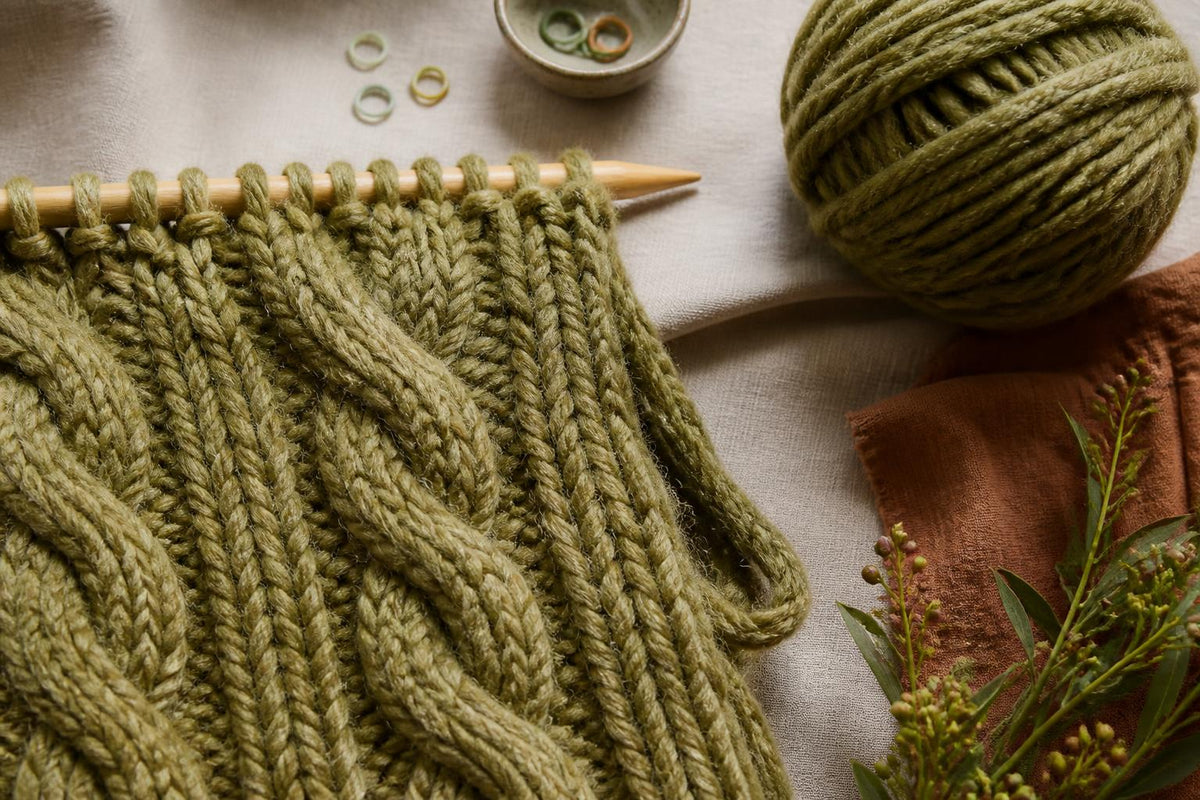
Choosing a pullover pattern you will actually finish starts with honesty, not ambition. The right project is one that suits how you knit now, how much repetition you enjoy, and how much decision-making you want to do along the way. A beautiful sample photo matters, but it matters less than clear instructions, manageable shaping, and yarn that behaves as the pattern expects.
If you have ever abandoned a garment halfway through, it was probably not because you lacked ability. More often, the pattern asked for too much patience, too many techniques at once, or too much trust in measurements that were never checked properly. A good pullover knitting pattern gives you enough challenge to stay interested, without making every stage feel like a hurdle.
What makes a good first or next pullover pattern
For a first pullover, we would usually steer you towards straightforward stockinette or garter, a simple crew or round neck, and a construction method with as few moving parts as possible. That might be a drop shoulder worked in pieces, or a top-down raglan with clear stitch counts. Neither is automatically better. What matters is whether the pattern explains each step clearly and whether the shaping is easy to track.
A pattern can be technically suitable and still be the wrong choice if it asks for a lot of endurance. Before you cast on, look at these points:
- How many separate pieces are there to knit?
- How often does the shaping change?
- Are there charts, written instructions, or both?
- Does the pattern expect techniques you have not used before, such as short rows, picking up neck stitches, mattress stitch seaming, or tubular cast off?
- Is there a lot of plain knitting between shaping sections, or is every row doing something different?
If you get bored easily, a large expanse of plain stocking stitch may be the real difficulty. If you prefer rhythm and routine, an all-over cable or colourwork yoke may be harder to finish than it first appears, even if you can technically do it.
Read the pattern overview before buying yarn. A well-written pullover knitting pattern usually tells you the construction method near the start. Terms such as “worked flat in pieces and seamed”, “worked top down in the round”, “set-in sleeves”, “drop shoulders”, and “circular yoke” are not just design notes. They tell you where the fiddly bits will fall.
For many knitters, the easiest route to a finished garment is one of these:
- Drop shoulder, worked flat, minimal shaping
- Top-down raglan, because you can try it on as you go
- Bottom-up simple body with straight sleeves, if you enjoy steady repetition
Patterns with set-in sleeves can fit beautifully, but they ask for more precision in shaping and sewing. Deep V-necks, folded collars, and complex stitch patterns at the same time can also turn a pleasant project into a long one.
If this is your next rather than your first pullover, choose one new skill only. For example, pair a familiar construction with a new neckline, or a plain shape with a new yarn type. That way, if something goes wrong, you only have one variable to troubleshoot.
How to read sizing, ease and finished measurements
The size on the pattern is only a starting point. Ready-to-wear sizing is inconsistent, and knitting patterns are built around body measurements plus ease. If you choose the size you normally buy on the high street, you are guessing.
Start with the wearer’s actual chest or bust measurement, taken over the clothing they are likely to wear underneath. Then look at the finished chest measurement in the pattern. The difference between those two numbers is the ease.
Positive ease means the garment is larger than the body. Negative ease means it is smaller and relies on stretch. For most everyday pullovers, positive ease is what gives comfort and layering room. How much depends on the style:
- Relaxed, oversized sweater, more positive ease
- Classic everyday fit, moderate positive ease
- Fitted knitwear, little positive ease or slight negative ease, depending on fibre and fabric
The pattern should tell you the intended ease. If it does not, calculate it from the sample size shown. If the model has a 97 cm bust and is wearing a garment with a 107 cm finished chest, that is 10 cm of positive ease. That tells you more than the size label ever will.
Also read beyond the chest measurement. Shoulder width, upper arm circumference, body length, and sleeve length often decide whether a pullover will be worn or ignored. A chest that fits is not enough if the sleeves are tight or the body is too long.
This is especially important with heavier yarns. A super chunky pullover can gain visual bulk quickly. If you choose too much positive ease in a thick fabric, the result may feel more coat-like than jumper-like. In a lighter yarn, the same amount of ease may look effortless.
Top-down patterns make it easier to adjust body and sleeve length as you go. Seamed patterns can also be adjusted, but only if you notice the issue before assembly. Measure a favourite existing jumper that fits well, then compare those flat measurements with the pattern schematic. That is often the fastest route to choosing the right size.
Why yarn choice changes the whole result
The same pattern can look crisp, slouchy, dense, airy, rustic, or polished depending on the yarn. Weight is only the start. Fibre content, ply structure, spin, and bloom all affect the final garment.
Yarn weight influences scale. A lace or 4 ply pullover can show delicate shaping and fluid drape. A DK or aran garment is often versatile and practical. A super chunky pullover is bolder, faster to knit, and usually warmer, but it will sit differently on the body. Seams become more substantial, necklines become more architectural, and every extra centimetre of ease has more presence.
Fibre changes behaviour. Wool has elasticity, memory, and warmth. Cotton is heavier and can drop with wear. Alpaca can be soft and warm but may grow and drape more. Acrylic can be practical and easy-care, but stitch definition and breathability vary widely. Merino is often chosen for softness and comfort against the skin, which can make it especially appealing for pullovers worn close to the neck.
Stitch definition matters too. Smooth yarns show cables, ribs, and textured stitches clearly. Fuzzier yarns soften detail. If a pattern relies on intricate texture, a yarn with strong stitch definition will help the design read properly. If the appeal is softness and halo, sharp stitch definition may matter less.
With World of Wool Chubbs, you are in the territory of soft, lofty, super chunky merino. That means quick progress and a very different fabric from a fine-gauge sweater. It can be ideal for a simpler silhouette where the yarn does the talking. A heavily cabled design in thick yarn can become weighty and rigid. A plain or lightly textured pullover often lets this sort of yarn shine.
Because thick garments use more fibre per row, drape changes quickly. A long-line tunic in a fine wool may feel graceful. The same shape in Chubbs may feel substantial. Shorter lengths, simpler sleeves, and uncomplicated necklines often work better in very thick yarns.
Colour also behaves differently in chunky yarn. Bold shades can look sculptural. Neutrals can highlight texture and shape. If you are deciding between options, it helps to look at colour palette inspiration for knitting projects before you commit.
Tension, needles and the swatch checks worth doing
If there is one step that saves more disappointment than any other, it is knitting a proper tension square. Not a hopeful corner. Not a quick measure over the first few rows of the sleeve. A real swatch, worked generously enough to measure the centre accurately.
The pattern tension tells you how many stitches and rows should fit within a stated area, usually 10 cm square. In UK patterns this may be called tension, while many US patterns say gauge. The principle is the same. If your stitches are too large, the garment comes out too big. If they are too small, it comes out too tight. In a pullover, row tension matters too, because it affects armhole depth, yoke depth, and overall length.
For a useful tension square:
- Use the yarn and needles you plan to use
- Knit a swatch larger than 10 cm, so you can measure the middle rather than the edges
- Wash and dry it as you intend to treat the finished garment
- Let it rest before measuring
- Count both stitches and rows
If the stitch count is off, change needle size and swatch again. If the stitch count matches but the row count does not, read the pattern carefully. Sometimes row gauge is less critical if lengths are given in centimetres and you are willing to measure as you go. Sometimes it is crucial, especially in shaped yokes or set-in sleeve constructions.
There are a few extra checks worth doing for pullovers:
First, hold the swatch up. Does the fabric suit the design? A pattern may technically match gauge on two needle sizes, but one fabric may feel board-like and the other floppy.
Second, weigh the swatch if you are concerned about garment heaviness. This is especially useful with thick yarns. A pullover can fit perfectly and still feel tiring to wear if the fabric is too dense.
Third, test the fabric after hanging for a short time, particularly with fibres prone to dropping. A swatch can grow after washing or under its own weight.
Fourth, check needle material as well as size. Some knitters work more tightly on metal than wood, or the reverse. Consistency matters more than theory.
If you crochet as well as knit, note that a pattern written in UK crochet terms is a separate issue from knitting terminology. It sounds obvious, but mixed-craft project bags are where confusion starts. Keep labels and notes with the project.
How much yarn to buy and how to avoid colour surprises
Buy yarn by quantity and by weight, not by optimism. The pattern should tell you how many balls or skeins are needed for each size, using the original yarn. Your job is to compare metreage, not just ball count.
If the pattern asks for 800 metres of an aran yarn and your chosen yarn has 80 metres per 100 g ball, you need enough balls to meet or slightly exceed that total. Round up, especially for larger sizes, longer sleeves, or if you plan any modifications. Running short near the end is rarely fixable by wishful thinking.
For a pullover, also consider these variables:
- Will you add length to body or sleeves?
- Are you knitting a larger size than the sample?
- Does the stitch pattern consume more yarn than plain stocking stitch?
- Are you making a roll neck, deep cuffs, or a folded hem?
- Does your personal tension use more yarn because your fabric is denser?
Heavier yarns make this even more important. A super chunky garment uses fewer rows, but each row consumes a lot of yarn. If you are planning a sweater in super chunky merino yarn for bold, quick-knit garments, check the pattern metreage carefully and allow for swatching.
Then there is colour consistency. For garments, matching the dye lot matters. A dye lot identifies yarn dyed together in the same batch. Even shades with the same colour name can vary slightly between batches. In a scarf, that may not matter. Across the front and sleeves of a pullover, it usually does.
Best practice is simple:
- Buy enough yarn for the whole project at once
- Check every ball has the same dye lot before winding or casting on
- Keep the labels until the garment is finished
- If you must combine different batches, alternate rows or rounds where practical to blend the transition
Alternating is especially helpful in large areas such as body sections, though it is less convenient in heavily textured patterns. In very chunky yarn, colour shifts can show more clearly because each stitch is visually larger.
If you are buying online from us at Native Yarns, it is still worth checking your yarn labels when the parcel arrives. That way, if there is any issue, you can sort it before the project is underway. As a live UK online shop operated by Fleeta Limited, we know that careful planning makes handmade projects more satisfying from the start.
Pattern details that save trouble at finishing stage
Finishing is where many nearly-done pullovers stall. The easiest garment to finish neatly is usually the one whose pattern anticipated real-life knitting, not just a flattering photograph.
Look for finishing instructions that are explicit. “Sew shoulder seams” is less helpful than instructions that tell you which method to use, how many stitches to join, and when to block. Good finishing notes reduce guesswork.
Construction affects finishing workload:
- Seamed garments can give structure and stability, especially at shoulders
- Seamless garments reduce sewing, but still need tidy transitions at underarms, necklines, and sleeve joins
- Drop shoulders are often the simplest to assemble
- Set-in sleeves usually demand the most careful seaming
Necklines deserve special attention because they sit against the skin and frame the whole garment. For an easy, wearable finish, crew necks and simple round necks are generally the least troublesome. Deep V-necks require neat edge treatment and accurate shaping. Folded collars look polished but add bulk and use more yarn. Boat necks can be elegant, but if the shoulder width is wrong they may slip or sit awkwardly.
Check whether the neckband is picked up and knitted after seaming, worked as you go, or sewn on separately. Picked-up neckbands are common and practical, but the pattern should give clear stitch counts or a pick-up ratio. Too many stitches and the neck flares. Too few and it puckers.
Sleeve style affects comfort as much as appearance. A wide drop sleeve can be forgiving and easy to knit. A slim fitted sleeve may look smart but needs accurate upper-arm measurement and sensible ease. If you dislike seaming but want structure, a top-down raglan often offers a good middle ground.
Also look for these small but valuable pattern details:
- Are there schematic drawings with measurements?
- Are lengths given in centimetres as well as rows?
- Does the pattern tell you when to block?
- Are finishing techniques named clearly?
- Are there notes on adjusting length or checking fit during knitting?
A pattern that explains these things is easier to complete well. That matters more than a dramatic photo.
If your goal is to finish and wear the pullover, choose a design that respects your time. Simple does not mean dull. A clean shape in good yarn, worked to the right measurements, often becomes the garment you reach for most.
The best pullover knitting pattern is not the most impressive one in your queue. It is the one whose sizing you understand, whose yarn suits the fabric you want, and whose finishing you can picture before you cast on. When those pieces line up, the knitting tends to keep moving, and the finished sweater has a far better chance of becoming part of everyday life.
Is a super chunky pullover a good beginner project?
Often, yes. super chunky yarn can make progress feel quicker and stitches easier to read, but the garment can become heavy. A simple shape with clear instructions is usually the best place to start.
How do I know if a pullover pattern matches my yarn?
Check the pattern’s stated yarn weight, fibre notes and tension. Then compare those with your yarn and knit a tension square. Matching the gauge matters more than using the exact same needle size.
Should I buy all the yarn for a pullover at once?
Yes, if you can. Buying the full quantity together gives you the best chance of getting the same dye lot, which helps the colour stay consistent across the whole garment.
What is positive ease in a pullover pattern?
Positive ease means the finished garment is larger than the wearer’s body measurement. It creates a looser fit. The pattern should say how much ease the designer intended.
Can I substitute merino for another fibre in a pattern?
Sometimes, but compare more than yarn weight. merino behaves differently from fibres with less stretch or more structure, so drape, warmth, stitch definition and final size can all change.