
Fast crochet projects you can finish this weekend
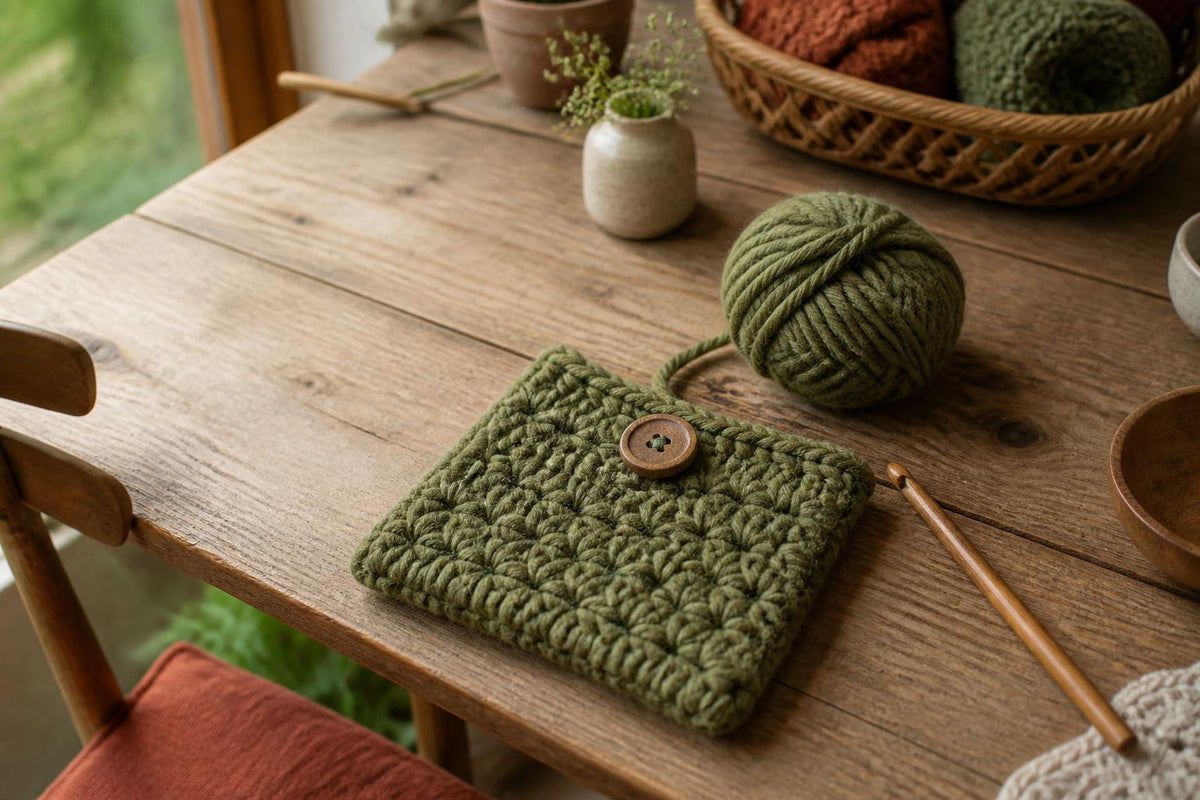
If you want a crochet project you can genuinely finish over a weekend, the fastest route is usually not the smallest pattern on the page. Speed comes from a sensible combination of stitch, yarn, hook size and finishing. A coaster worked in fine cotton with a tight tension can take longer than a cowl in soft, thick wool. That is why it helps to look past the word “quick” in a pattern title and judge what the project will actually ask of your hands.
When we talk about quick crochet patterns free of charge online, we look for patterns that are short on shaping, easy to memorise and light on assembly. A fast make should let you settle into a rhythm, see progress early and finish neatly without spending half your Sunday sewing pieces together.
What makes a crochet pattern genuinely quick
A crochet pattern is genuinely quick when the making time is short from start to finish, not just when the written instructions fit on one page.
The first factor is stitch choice. Tall stitches such as treble crochet and double treble crochet build fabric faster than double crochet because each row gains more height. Mesh, chain spaces and simple repeats also speed things up because you are not placing a stitch into every single point across the row. Dense textures can be beautiful, but bobbles, post stitches and heavily layered patterns slow the work considerably.
The second factor is yarn weight. Thicker yarn usually means fewer stitches and rows. That is why many weekend projects are worked in bulky or super chunky bases. A simple cowl in super chunky merino yarn can move along very quickly, especially if the stitch pattern is straightforward. By contrast, a similar size project in DK or 4 ply can be a longer commitment even when the pattern itself is not difficult.
Project size matters, but not always in the obvious way. A tiny object with lots of detail, colour changes or fiddly edging may take longer than a generous scarf worked in one repeat. We suggest looking at the total stitch count, the number of separate pieces and whether there is shaping. Flat rectangles and tubes are often the quickest structures to complete.
Finishing time is the part many crocheters underestimate. A “fast” project stops feeling fast if it includes six seams, fifteen ends to weave in and a decorative border that doubles the working time. Before you begin, check how many balls of yarn are involved, whether there are colour joins at every stripe, and whether the project needs lining, blocking or assembly.
A good quick project usually has these qualities:
- one main stitch pattern
- one or two ends per ball, not dozens from small colour sections
- little or no shaping
- minimal sewing up
- simple edging, or none at all
- an easy-to-check stitch count
If you want visible progress, choose a pattern where each round or row clearly changes the size. Baskets, wraps, cushion fronts and cowls are satisfying for this reason. You can see the finish line getting closer.
How to choose the right free pattern for your skill level
A free pattern only feels quick if it suits your current skill level. If the instructions use techniques you have never tried, your weekend project becomes a lesson, which is perfectly worthwhile, but not necessarily fast.
For beginners, the best choice is a pattern using one basic stitch or a very short repeat. Look for clear notes at the top of the pattern, a materials list with one yarn weight, and instructions written row by row or round by round. A beginner-friendly pattern should explain whether it uses UK crochet terms or US terms, and it should state the finished measurements. If that information is missing, pause before starting.
Confident improvers can move into patterns with simple texture, working in the round, basic increases and decreases, or a repeating lace sequence. At this stage, the pattern should still be easy to read at a glance. If every row is different, or if there are several special abbreviations, it may not be your quickest option.
Experienced crocheters can complete more complex projects quickly because they spend less time decoding the instructions. Even so, speed still depends on design choices. A skilled crocheter may finish a textured basket in a day, but still take a full weekend over a finely worked shawl in lightweight yarn.
Before starting any free pattern, we recommend checking:
- whether the pattern states the skill level
- whether there is a full materials list
- whether the finished size is given
- whether the abbreviations are explained
- whether there are photos of key stages, not just the final piece
- whether the comments or notes mention errors or corrections
Be honest about what slows you down. Some people work stripes quickly but dislike sewing. Others are happy with shaping but lose momentum when counting long foundation chains. The right pattern is not just “easy”, it matches the part of crochet you already do comfortably.
If you are choosing yarn before choosing a pattern, it can help to think in the other direction too. Our guide on choosing patterns to suit the yarn you already have is written with knitting in mind, but the same practical thinking applies to crochet, especially when weight, drape and stitch definition matter.
The best types of small projects when you want a fast result
When you want a satisfying finish by Sunday evening, some project types are more realistic than others. Small crochet projects work best when they are useful, simple in shape and forgiving in fit.
Home accessories are often the strongest option. Think mug rugs, face cloths, simple baskets, cushion covers, hot water bottle covers and table mats. These pieces are usually square, rectangular or cylindrical, so they avoid complicated shaping. They also let you practise even tension and neat edges without the pressure of garment sizing.
Simple wraps are another excellent category. A narrow scarf, short cowl or small shoulder wrap can be very manageable in thicker yarn. They give that pleasant sense of making something substantial, but the construction is often just a long rectangle or a joined tube. For many crocheters, this is a better quick project than a hat, because hats can involve crown shaping, accurate sizing and less room for tension variation.
Practice pieces are worth including too, especially if your real aim is to build confidence. A set of matching swatches in different stitches, a textured panel that could become a cushion front later, or a sampler strip for borders and edgings can all be useful weekend makes. These are not second-best projects. They help you understand how yarn behaves, how much drape a stitch has, and whether a hook size feels right in your hand.
Good quick-project categories include:
- baskets worked in one piece
- face cloths and spa sets
- cushion panels
- table runners in a simple repeat
- cowls and neck warmers
- straightforward scarves
- decorative bunting
- stitch sampler panels
We would be cautious about calling fitted garments “weekend projects” unless they are extremely simple and worked in very thick yarn. Even then, garments bring sizing, shaping and finishing demands that can easily push the project into next week.
Yarn, hook size and tension choices that save time
The yarn you choose has a direct effect on speed, appearance and finishing. If your aim is a fast result, thicker yarn is usually the simplest place to start. Fewer stitches mean quicker progress, and a slightly larger hook is often easier for tired hands over a concentrated weekend of making.
That said, thickness is not the only consideration. Fibre matters too. Wool and merino often have helpful elasticity, which can make stitches easier to form evenly. Cotton gives crisp definition but can feel slower because it has less bounce. Acrylic blends may be practical for household items, while wool-based yarns can be especially pleasant for wraps and cowls.
For a bold, quick-moving project, many crocheters enjoy working with soft, lofty super chunky yarns. In our own range at Native Yarns, operated by Fleeta Limited, World of Wool Chubbs is a super chunky merino yarn that suits projects where you want visible progress and a soft finish. For educational comparison, lighter categories such as DK yarn for smaller stitch counts and lighter fabric can also be useful, but they will rarely be the fastest option for a weekend make.
Hook size changes more than speed. A larger hook can make fabric grow faster, but if you go too large for the yarn, the stitches may look loose and untidy. A smaller hook may create a firmer, neater result, but it can slow you down and use more yarn. We suggest starting with the hook size recommended for the yarn, then making a small tension square before committing to the full project.
A tension square is worth the time, even for a quick pattern. It tells you three practical things:
- whether your finished size will be close to the pattern
- whether you like the fabric at that hook size
- whether the yarn quantity is likely to be enough
For UK readers, this matters especially when the pattern gives dimensions in centimetres but the yarn recommendation is vague. A ten minute square can prevent a two hour restart.
Also check the dye lot before you begin. If your project needs more than one ball, compare the labels before winding or stitching. Colour variation between batches can be visible, particularly in larger plain areas. If balls from different batches must be used, alternating them every couple of rows or rounds can help blend the change. It is much easier to plan this at the start than to discover it halfway through a cowl.
Where to find free patterns and how to assess them safely
There are many authorised free patterns online, and many are excellent. The challenge is sorting the clear, trustworthy instructions from copied, incomplete or poorly converted versions.
We suggest starting with reliable sources such as yarn brands, established designers, magazines, craft publishers and well-maintained shop journals. These are more likely to provide full materials lists, clear photographs and corrections if an error is found.
When you assess a free crochet pattern, check first whether it clearly states which terminology it uses. UK crochet terms and US terms are not interchangeable. A UK treble is not the same stitch as a US treble. If the pattern does not say, look at the stitch list. If it includes both “single crochet” and “double crochet”, it is almost certainly written in US terms. If it lists “double crochet” as a basic stitch and there is no “single crochet”, it may be in UK crochet terms. Do not guess if the fabric size matters.
Be careful with patterns that appear as image collages, copied social posts or unattributed PDFs shared repeatedly across different websites. Signs of a weak or unsafe pattern source include:
- no designer name or publisher
- no yarn quantity
- no finished measurements
- no statement of terms used
- blurry charts or cropped instructions
- wording that changes halfway through, suggesting it has been copied
- no permission statement where the pattern is clearly reposted
For UK readers, there is also a practical point about measurements and yarn naming. A pattern from outside the UK may use yarn category names that do not neatly match UK labels, and hook sizes may be paired with a different style of fabric than you expect. Read the meterage and the gauge, not just the yarn description.
If a pattern asks you to download a file, use the same caution you would for any online document. Prefer recognised websites, avoid suspicious redirects, and check whether the page itself already gives enough information to judge the pattern before you click.
How to finish quick crochet projects neatly without slowing yourself down
A quick project still deserves a tidy finish. The good news is that neat finishing does not have to take long if you build it into the making process.
Start by counting stitches as you go. This is the fastest way to avoid a wonky edge or a panel that mysteriously narrows. Count the first few rows, then count at regular intervals, especially after interruptions. It takes less time to correct one row than to discover the problem at the end.
Use stitch markers freely. Mark the first and last stitch of a row if your edges tend to wander. Mark the start of the round if you are working continuously. Mark pattern repeats if a sequence is easy to lose. These tiny checks keep a fast project fast.
When joining pieces, choose the simplest method that suits the item. A cushion panel might only need a straightforward double crochet join or an easy seam through the back loops. Decorative joins can look lovely, but they are not always worth the extra time on a weekend make.
Weaving in ends is where many projects lose momentum. Our practical rule is to weave in each end as soon as that section is complete, or at least at the end of each session. Leaving every end until the last hour makes the finish feel slow. Use a blunt needle, follow the path of the stitches, and weave in one direction and then back through a different route for security.
Blocking depends on the fibre and the project. Not every quick project needs formal blocking, but many benefit from a light finish. A simple steam or damp block can even out edges and help the stitches settle. Take care with heat. Wool and merino respond differently from acrylic, and too much direct heat can damage the fabric. In the UK, many yarn labels will state washing and drying guidance clearly, while imported yarns may use symbol-only care instructions, so it is worth checking before you press or wash.
For basic care after finishing:
- store the project clean and dry
- avoid hanging heavier crochet pieces that may stretch
- wash according to the yarn label
- dry flat where shape matters
- keep a note of the yarn used in case you want to make a matching piece later
A weekend crochet project is most satisfying when it is both quick and complete. The real aim is not simply speed, but a finished piece that looks intentional, feels good to use and teaches you something for the next make. If you choose the pattern carefully, match it to the right yarn and keep finishing simple, free crochet patterns can absolutely give you that result in a couple of days.