
How to choose a yarn bowl that keeps yarn clean
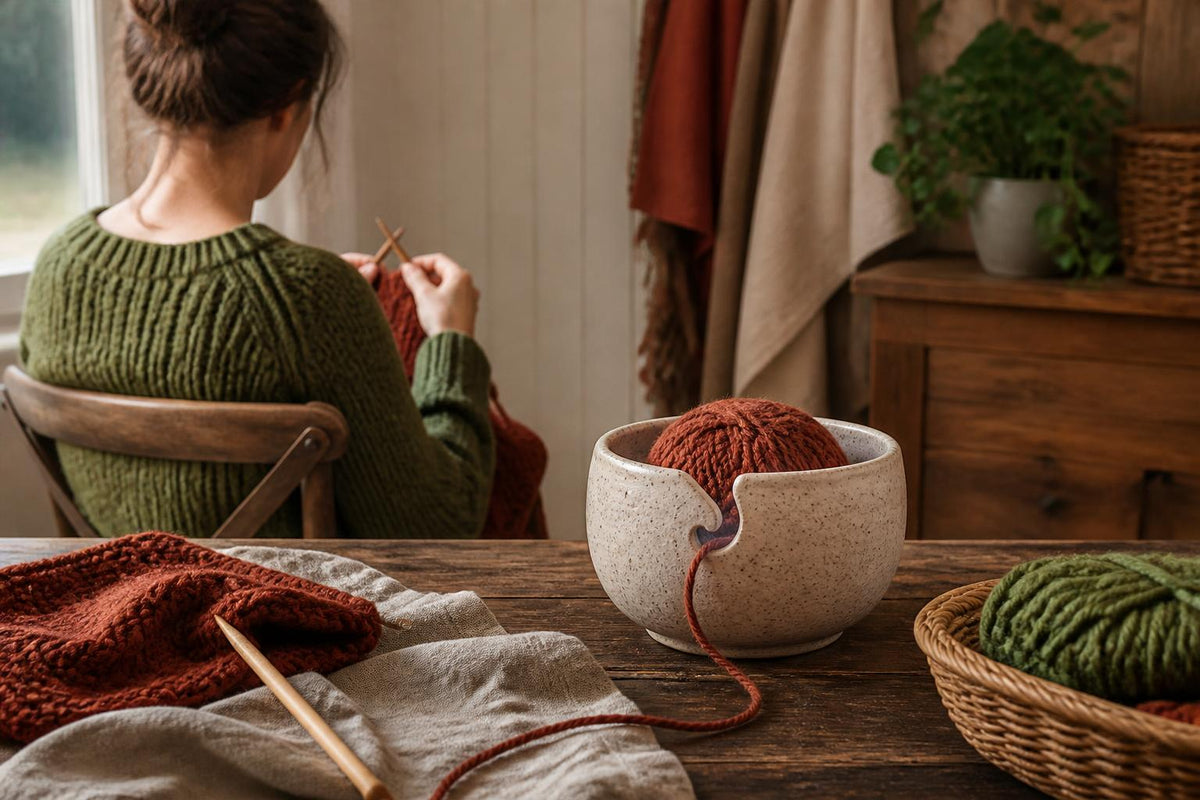
A yarn bowl is worth choosing carefully if you want it to do more than look nice on a shelf. The best ones keep the working strand moving smoothly, stop the ball from rolling across the floor, and help keep yarn away from dust, pet hair and general household clutter. If you are deciding between a purely decorative piece and one you will use every week, practical details matter more than the pattern painted on the outside.
That does not mean appearance is irrelevant. A Cute yarn bowl can be genuinely useful if its shape, weight and finish are right. The trick is to tell the difference between a bowl that happens to be attractive and one that is so decorative that it becomes awkward in real knitting or crochet use.
What a yarn bowl actually does
A yarn bowl gives the yarn a fixed place to sit while you work. Instead of the ball or cake moving freely on the sofa, table or floor, it stays inside the bowl and feeds out through a slot or hole. That simple bit of control solves several common annoyances.
First, it reduces rolling. Anyone who has watched a ball of wool travel under a chair knows how quickly yarn picks up fluff. A bowl limits that movement. The yarn stays contained, so it is less likely to collect dust, pet hair or bits from the carpet. If you are working with pale shades, this matters even more, because marks and debris show up quickly.
Second, it guides the strand. Good tension depends on a smooth, predictable feed. A yarn bowl will not replace hand control or a proper tension square, but it can make the yarn easier to manage, especially if you are crocheting quickly or knitting from a slippery wound ball. The strand comes from one point rather than changing direction every few rows.
Third, it keeps your project area tidier. That is useful at home, but especially useful if you work in short sessions and need to put things down often. If your yarn stays in the bowl between sessions, it is less likely to become tangled with needles, hooks, stitch markers or the rest of the contents of your project bag.
A bowl can also help when you are switching between different working spots in the house. If you knit on the sofa one evening and at the kitchen table the next, having the yarn already contained makes setup easier. It is not a storage solution in the same way as project bags and yarn storage options, but it does make active projects more manageable.
What it does not do is make every yarn behave perfectly. Some fibres are more grabby, some balls are wound too tightly, and some novelty textures catch on almost anything. A bowl helps most when the yarn has been wound neatly and the bowl has a smooth path for the strand to follow.
Which features make a yarn bowl useful
The first thing to assess is weight and stability. A very light bowl can slide or tip as the yarn pulls against it. That defeats the point. Heavier ceramic, wood with a broad base, or other solid materials usually perform better than very thin lightweight options. We look for a base that sits flat and does not rock if nudged. If you often work on a soft sofa cushion rather than a firm table, stability matters even more.
Next comes the entry slot, sometimes a spiral cut-out, sometimes a simple curved slit with one or more feeding holes. The shape should let you place the yarn in easily, but hold it securely enough that it does not jump out during use. A smooth spiral is popular because it keeps the strand in place while still allowing you to remove the project without cutting the yarn. The important detail is not the style itself, but the finish. Run a finger all the way around the slot. Any roughness, ridge or sharp edge can catch fibres.
A smooth interior matters just as much. Glazed ceramic should feel even, not gritty. Wooden bowls should be sanded and sealed properly, with no splinters around the rim or slot. If the inside has carved decoration, check whether the yarn will brush against it as the ball turns. Texture on the outside is mostly harmless. Texture where the yarn travels is not.
Capacity is another practical point that is easy to underestimate. Many bowls are photographed with a neat little cake of DK yarn, but your real projects may involve larger quantities or bulkier fibres. If the yarn is packed too tightly into the bowl, it will not rotate or feed cleanly. You end up tugging the strand, which can tip the bowl or distort your tension.
Think too about the type of yarn put-up you use most often. A yarn bowl may suit centre-pull cakes, hand-wound balls, or commercially wound balls differently.
Centre-pull cakes often work well in a bowl if there is enough room for the cake to sit without rubbing hard against the sides. The outer shell of the cake should not collapse and jam as the centre strand is pulled.
Hand-wound balls often benefit most from a bowl because they are the most likely to roll away. They usually rotate from the outside, and that movement is exactly what a stable bowl is designed to manage.
Commercial balls can be less predictable. Some unwind smoothly from the outside, while others loosen suddenly and tangle if confined too tightly.
If you regularly work with more substantial fibres, it helps to compare bowl size with the yarns you actually use. For bulky makes, a bowl that suits our super chunky merino yarn range will be much more useful than a small decorative bowl made for finer yarns.
How to match bowl size to your yarn and project
The easiest way to choose the right size is to start with your most common project, not with the bowl itself. Ask what usually sits beside you while you work. Is it a compact 50g cake of sock yarn, a standard ball of DK, or a large hand-wound ball for a blanket?
For finer yarns, including lace, 4 ply and many DK projects, a smaller bowl can be enough. These yarns take up less space and usually pull with less force. Even so, leave room around the yarn. The ball or cake should move freely rather than scraping the sides.
For aran and heavier worsted-style yarns, move up in diameter and depth. If you often compare project plans across weights, it can help to think in terms of how much yarn bulk changes between categories. A bowl that is comfortable for DK yarn for everyday garments and accessories may feel cramped once you switch to thicker strands or larger wound balls.
For bulky and super bulky projects, capacity becomes the deciding factor. This is particularly true with lofty fibres and hand-wound cakes, which can be much larger than people expect. World of Wool Chubbs super chunky merino is a good example of a yarn that asks more from a bowl. Chubbs is soft, substantial, and designed for bold stitches. A bowl for that kind of yarn needs enough width for the ball to turn easily and enough weight not to be pulled over by a firmer draw on the strand.
If you are planning a hat or cowl in super chunky merino, you may only have one ball in use at a time, but that one ball can still be too large for a small ceramic bowl. For a blanket, oversized scarf or cushion cover, you may decide that a bowl is less practical than a larger open project basket, especially if you are alternating balls.
There is also a difference between fibre behaviour. Smooth wool blends and tightly spun yarns often feed cleanly. Loftier merino can expand slightly and catch more if squeezed into a narrow space. That does not mean it is unsuitable for a bowl, only that you need enough clearance.
A useful test is to picture the yarn at its fullest, not halfway through the project. A bowl that works beautifully when the ball is nearly used up may be frustrating for the first third. If you buy yarn in batches for a larger make, keep the dye lot organised separately and only place the active ball in the bowl. The bowl is for feeding yarn, not for storing the whole project quantity.
If you use both knitting and crochet, consider your working style as well. Fast crocheters, particularly those using UK crochet terms and making repetitive stitches at speed, often pull yarn more briskly than knitters working in shorter motions. A larger, steadier bowl can cope better with that movement.
When a cute design is helpful and when it gets in the way
A well designed bowl can absolutely be attractive. We understand why people look for a Cute yarn bowl rather than a plain utilitarian one. You will probably keep it in sight, use it often, and want it to suit your home and your craft corner. Good design can make a tool more inviting to use.
Where appearance helps is in visibility, finish and enjoyment. A bowl you like looking at is more likely to stay within reach and become part of your regular setup. A clearly shaped rim and slot can also make the yarn path easier to see, which is genuinely practical.
Where appearance gets in the way is when novelty overtakes function. Extremely narrow openings, sculpted shapes with tails, ears or feet, heavily carved rims, and decorative cut-outs near the yarn path can all create snag points or make the bowl unstable. If the base is small compared with the height, it may tip. If the slot is intricate rather than smooth, fibres may catch.
This is especially important with softer yarns. Merino, alpaca blends and gently spun singles can pick up on tiny rough spots that a smoother, firmer yarn might ignore. One barely noticeable flaw in the glaze or wood finish can become irritating very quickly.
Material choice matters here too. Ceramic bowls are often the heaviest and most stable, but they can chip if dropped. Wood is warmer to handle and often lighter to carry, but it needs a very good finish. Metal can work, though it is less common, and it should be checked carefully for seams. Resin and novelty materials vary widely. We would be cautious if the inside surface feels tacky, uneven or overly lightweight.
A decorative bowl is useful when the decoration sits outside the yarn’s route. Painted motifs, colour, a pleasing silhouette and a well proportioned shape can all add charm without affecting performance. A cute design becomes a problem when it changes the balance, narrows the interior too much, or introduces texture where the yarn needs to glide.
So if you are choosing between two bowls, pick the one that is pleasant to live with and easy to use. The prettier option is only the better option if it still behaves like a proper tool.
Do you need a yarn bowl at all?
Not everyone does. If you usually work from centre-pull cakes that sit neatly beside you, have a pet-free workspace, and put projects away after each session, a yarn bowl may be nice rather than necessary. The same applies if you mostly make smaller items and do not find rolling yarn especially annoying.
A yarn bowl is most useful if your yarn often ends up on the floor, if you work in a shared living space, or if you like to keep one active project set up and ready to pick up. It can also help if you are trying to keep lighter shades cleaner, or if you want a more consistent feed from hand-wound balls.
There are simple alternatives. A project bag with a yarn guide hole, a clean basket, a deep fabric pouch, or even a smooth-sided storage box can keep yarn contained. Those options are often better for larger projects or multiple balls. If portability matters more than tabletop use, a project bag may serve you better than a bowl.
At home, some people use a large mug, a clean mixing bowl, or a lidded box with the lid slightly ajar. These improvised options can work surprisingly well as long as there are no rough edges and the yarn can move freely. They are less elegant, but they answer the practical question.
Our view is simple. Buy a yarn bowl if your knitting or crochet habits will actually benefit from one. Choose it as a working tool first and a decorative object second. If you love a Cute yarn bowl and it is also stable, smooth and large enough for the yarns you use, that is exactly the right combination. If it is beautiful but fiddly, it will spend more time on a shelf than in your hands.
For many makers, the best setup is a mix of tools. A bowl for the current ball, proper storage for the rest of the yarn, and thoughtful project planning from the start. If you are still deciding what fibres and weights suit the kind of making you enjoy, browsing super chunky yarn for quick, bold projects alongside finer options can help you judge what sort of bowl capacity you would really use.
Native Yarns is operated by Fleeta Limited, and we always come back to the same principle, choose tools that make the craft calmer, cleaner and easier to return to. If a yarn bowl does that for you, it earns its place.
Can a yarn bowl change my tension?
Not directly. A yarn bowl should let yarn feed smoothly rather than add drag. If the strand catches or pulls, it can affect consistency, so a smooth opening matters.
Is a yarn bowl useful for crochet as well as knitting?
Yes. It can help with either craft by stopping the yarn ball from rolling away and by keeping the working strand in one place while you stitch.
Will a yarn bowl work with super chunky yarn?
Sometimes, but capacity is the key issue. Bulkier yarn needs a larger bowl and a wide, smooth opening so the strand can move freely without rubbing.
Are ceramic yarn bowls better than wooden ones?
Neither is automatically better. Ceramic is often heavier and stable, while wood can feel warmer and lighter. The finish, smoothness and base grip matter more than the material alone.
What should I check before buying a decorative yarn bowl?
Look for a smooth yarn path, enough internal space, a stable base and no rough edges. Decorative cut-outs and novelty shapes should not create snag points.