
Choosing blanket yarn that stays soft and holds shape
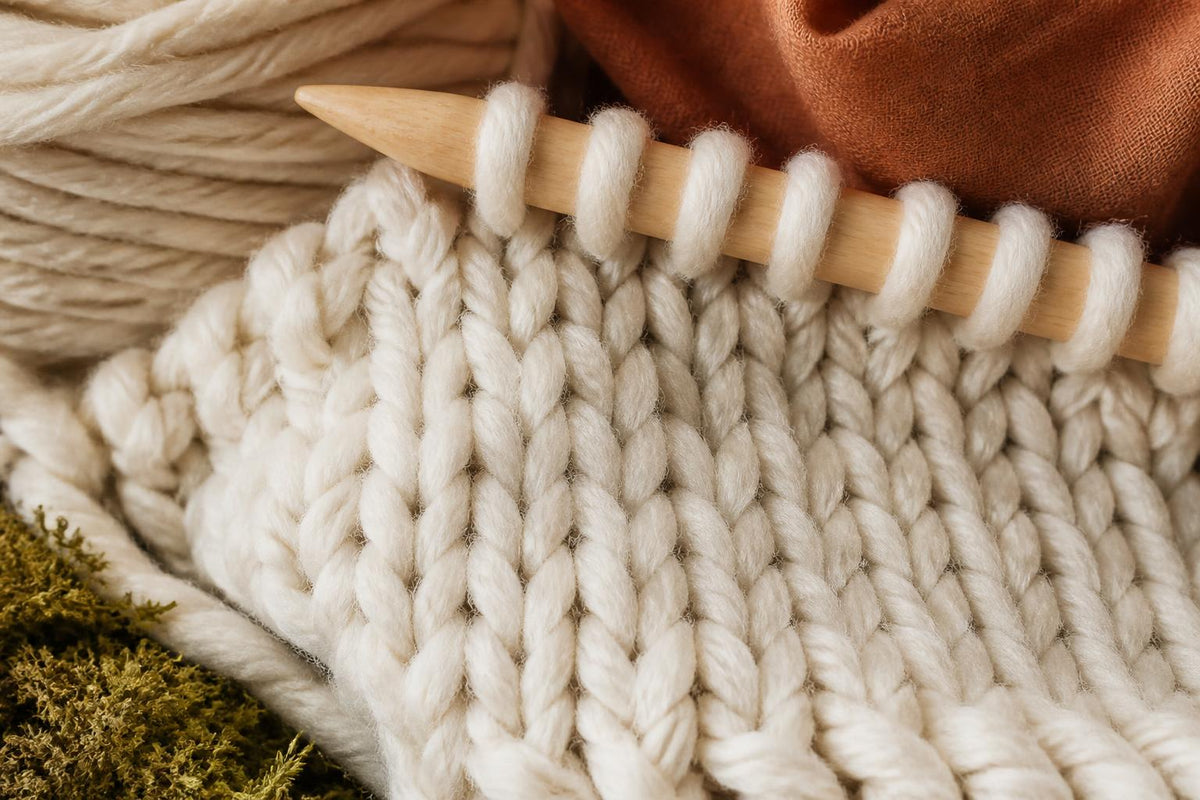
A blanket lives with us differently from a hat or a scarf. It is folded and unfolded, pulled over knees, washed more often, and expected to feel good against bare skin for years. That means the best yarn is not simply the softest skein on first touch. It needs to keep its structure, recover after use, and suit the amount of care the blanket will realistically get at home.
If you are choosing wool for knitting blankets, start with the finished use rather than the pattern photo. A blanket for a sofa, a baby gift, or a bed all asks different things of the yarn. Fibre, weight, twist, stitch pattern and care instructions all matter, and getting those decisions right at the start saves disappointment later.
What makes a good yarn for a knitted blanket
A good blanket yarn balances six things well, softness, warmth, weight, durability, drape and ease of care.
Softness is usually the first priority, and rightly so. Blankets sit close to the skin, often over arms, shoulders and legs, so any prickle becomes tiring very quickly. But softness on the ball band is not the whole story. Some yarns feel silky in the hand yet pill quickly, flatten with use, or lose definition after washing. For a blanket, we want softness that lasts.
Warmth matters, but more warmth is not always better. A very dense blanket can become too hot indoors, especially in centrally heated UK homes. The best choice often has enough loft to trap warmth while still breathing. Wool does this naturally better than many synthetic fibres, because it insulates without feeling clammy.
Weight is often underestimated. A blanket can use a large quantity of yarn, and the total finished weight changes how practical it is. A heavy throw can feel luxurious on a bed or armchair, but tiring if you want to move it around the house or knit it in one piece on your lap. The thicker the yarn, the faster the project grows, but the more substantial it becomes.
Durability is essential for anything that will be used regularly. A blanket is exposed to friction from clothing, pets, upholstery and repeated folding. Yarns with a good twist and resilient fibre tend to hold up better than very loose, airy constructions. This is one reason to think beyond first impressions and consider how the yarn behaves over time.
Drape affects both appearance and comfort. A blanket with too little drape can feel board-like, especially in a simple stitch pattern. Too much drape, and it may stretch out or lose crisp edges. The right balance depends on whether you want a structured textured throw, a relaxed sofa blanket, or a soft nursery wrap.
Ease of care often decides whether a handmade blanket becomes an everyday favourite or a cupboard piece. Before buying, ask how often it is likely to need washing, who will use it, and whether hand washing is realistic. For many households, especially with children or pets, care requirements need to be straightforward enough to keep the blanket in use.
These same principles apply whether you knit or crochet, though fabric density differs and can affect the amount of yarn needed. If you also make blankets in crochet, it helps to remember that patterns written in UK crochet terms can produce a denser fabric than a comparable knitted piece, which changes warmth, drape and quantity.
How fibre choice changes the finished blanket
Fibre changes almost everything about a blanket, from how it feels on day one to how it behaves after months of use.
Merino is popular for blankets because it combines softness, warmth and elasticity. Good merino has a smooth, springy handle that feels comfortable next to skin, and it tends to give knitted stitches a neat, even look. It also regulates temperature well, which is useful in the UK where indoor temperatures can vary across seasons and older houses are not always evenly heated.
Compared with standard wool, merino is usually softer and less scratchy. That makes it a strong choice for throws, lap blankets and family blankets that will be handled often. It also has good natural resilience, so the fabric can recover well after being folded or lightly compressed.
British wool and other traditional wool types can make excellent blankets too, but they usually create a more robust, rustic feel. They may be ideal where durability and structure matter more than softness, for example in a heavily textured throw or a blanket intended for hard wear. The trade-off is that some people find them less comfortable against bare skin.
Cotton behaves very differently. It is cooler, less elastic, and often heavier for the same size of blanket. Cotton blankets can be a good choice for warmer weather, for people who dislike wool, or for a crisp modern look, but they do not trap warmth in the same way. They also tend to show less bounce in textured stitches. If you are comparing fibres for different projects, our guide to choosing cotton and wool without costly mistakes explains where each performs best.
Acrylic and acrylic blends are common in blanket making because they are widely available and often simple to wash. They can be practical, but the feel varies greatly. Some are pleasantly soft, while others can feel squeaky, static-prone or less breathable. They may also hold odour more readily than wool and can behave differently under heat, so drying and blocking need care.
Alpaca brings softness and warmth, but often with more drape and less elasticity than merino. That can be beautiful in a fluid blanket, though it may not hold sharply textured stitches as clearly. It can also grow more in use if the fabric is knitted loosely.
Blends are often where blanket yarn becomes most balanced. Wool blended with synthetic fibre can improve durability or ease of care. Wool blended with alpaca can increase softness and warmth. Cotton blends can lighten the feel of a warm-weather throw. The right answer depends on how you want the blanket to live in your home.
For many UK makers, merino sits in the sweet spot. It feels soft enough for close contact, insulates well in a draughty room, breathes better than most synthetic options, and gives a polished finish. If you are weighing up fibres for other hand-knit projects too, our article on how to choose wool for hand knitting with confidence is a useful comparison point.
When super chunky merino is the right choice
There are blanket projects where a finer yarn is the better engineering choice, especially if you want a lighter fabric or a very large bedspread. But when you want speed, presence and real softness, super chunky merino comes into its own.
This is exactly where World of Wool Chubbs works especially well. Chubbs is a super chunky merino yarn, and that combination suits blankets that are meant to feel generous, textured and immediately cosy. The thickness builds fabric quickly, which is helpful if you want a satisfying project that shows progress fast. It also makes the knitting itself easier to read, because each stitch is more visible.
That visibility matters for texture. Rib, moss stitch, seed stitch, simple cables and broken rib all show clearly in super chunky merino. If you enjoy the look of bold stitch patterns without needing intricate chart work, this weight does a lot of the visual work for you. The scale feels modern and inviting, especially in throws for sofas, reading chairs and guest rooms.
Stitch definition is another advantage. Merino has enough spring to help knit stitches sit neatly, and in a thick yarn that can make even straightforward patterns look deliberate and refined. Garter stitch, which can look humble in a finer yarn, becomes deeply cushioned and sculptural at this scale.
Super chunky merino is also a good choice when you want the blanket to feel substantial without becoming stiff. A very bulky synthetic yarn can sometimes create a fabric that is lofty but less breathable. A merino version tends to feel warmer in a more balanced way, with better airflow and a more natural hand.
Where is it less suitable? Very large blankets can become physically heavy in super chunky yarn, both to knit and to use. If you are making a full bed blanket in one piece, think carefully about total weight and storage. It may still be the right choice, but you might prefer panels, a modular construction, or a smaller finished size such as a lap blanket or sofa throw.
If you are deciding between very thick yarn options, our guide to choosing jumbo knitting yarn for cosy projects helps explain when extra thickness improves a project and when it becomes too much.
How much yarn do you need for a blanket?
Blanket quantities vary more than many knitters expect. Finished size is only the starting point. Stitch pattern, needle size, yarn weight and your personal tension all change the amount needed.
A simple stocking stitch or garter stitch blanket will usually use less yarn than a heavily textured blanket of the same size. Cables, bobbles and dense slip stitch patterns consume more. So do tighter gauges and smaller needles. Openwork, by contrast, may use less yarn, though it also changes warmth and practicality.
As a rough planning method, decide first on the blanket type. A pram blanket, lap blanket, sofa throw and bed blanket are very different commitments. Then check the ball weight and meterage, not just the number of balls. Two yarns may both be labelled super chunky, but if one ball contains less meterage, you will need more of it.
Before buying the full quantity, knit a proper tension square. For a blanket, we recommend making it larger than the minimum pattern gauge square if possible, because a tiny swatch can be misleading in thick yarn. Measure the centre after relaxing the fabric, and if you plan to wash the finished blanket, wash and dry the swatch the same way first.
A tension square tells you three practical things. First, whether you like the fabric at that needle size. Second, whether your stitch and row counts match the pattern closely enough. Third, how much yarn your own knitting style uses. Even when a pattern gives quantities, a loose knitter and a tight knitter can arrive at different totals.
If you are designing your own blanket, one useful method is to weigh the swatch after washing, calculate its area, and scale up to the planned blanket size. This is often more reliable than guessing from meterage alone, especially with textured stitches.
Always allow extra for borders, joining, seaming and any changes of plan. Blankets are long projects, and most of us adjust something as we go. Running short near the end is frustrating, particularly if the original shade or dye lot is no longer available.
Why dye lot and colour planning matter
Large projects show colour inconsistency more clearly than small ones. A slight variation between batches may disappear in a hat, but it can stand out across the width of a blanket. That is why dye lot matters so much.
A dye lot is the batch reference showing yarn dyed together under the same conditions. Even when the shade name is identical, a different dye lot can be a touch lighter, darker, warmer or cooler. In a blanket, especially one worked in broad uninterrupted sections, that change may look like an accidental stripe.
The simplest way to avoid this is to buy enough yarn for the whole blanket at once, checking that all balls carry the same dye lot where the product is batch labelled. If extra yarn may be needed, it is often wiser to buy a little more from the start than to try to match later.
If you do need to combine balls from different batches, alternate them across a few rows at the changeover rather than switching abruptly. That helps blend any slight variation. In a striped or modular blanket, planned colour changes can disguise this more easily than a single-colour design.
Colour also affects how texture reads. Pale and mid-tone shades usually show stitch definition clearly. Very dark colours can hide intricate texture, while highly variegated shades may break up cables or moss stitch visually. That is not a fault, it is simply a design choice. If the texture is the star, choose a colour that lets it be seen.
Joins and borders deserve planning too. A contrast border can frame a blanket beautifully, but it also makes uneven edges more visible. A matching border is often more forgiving. If you are making panels or squares, think early about whether the join should blend in or become part of the design.
At Native Yarns, operated by Fleeta Limited, we always suggest treating blanket yarn as a full-project purchase rather than a buy-now, top-up-later project if consistency matters to you.
How to care for a knitted blanket so it lasts
The best care plan starts before you cast on. If a blanket will live on a sofa, be used daily and occasionally end up on the floor, choose a yarn whose maintenance suits real life.
For wool blankets, read the care instructions on the label and trust those over assumptions about the fibre. Not all wool is cared for in the same way. Some merino yarns are suitable only for hand washing, while others may have different finishing treatments. If the label says hand wash, plan on cool water, a wool-safe detergent, minimal agitation and careful support when lifting the wet blanket.
Drying matters as much as washing. A knitted blanket should usually be dried flat, reshaped gently and kept away from direct high heat. Hanging a wet wool blanket can stretch it badly because of the water weight. Tumble drying is risky unless the label explicitly says it is safe.
Routine handling makes a difference too. Fold rather than hang for storage. Keep the blanket clean before putting it away for a season, because moths and carpet beetles are drawn to natural fibres carrying skin oils and food traces. In the UK, that matters especially in lofts, cupboards and spare rooms where textiles may sit undisturbed for months.
Use breathable storage, not airtight plastic for long periods if the item is not fully dry and clean. Cotton storage bags or clean pillowcases are often better for natural fibres. If you use deterrents for pests, keep them appropriate for textiles and avoid anything that could stain the yarn.
Pilling is normal to some extent in soft wool, especially where there is repeated friction. A blanket used across jeans, upholstery or pet bedding will show wear sooner than one kept mainly for occasional use. Remove pills gently by hand or with a tool intended for knitwear, and do not overwork the surface.
Finally, wash less often than you might think. Wool naturally resists odour and can often be refreshed by airing. Spot cleaning and a good airing near an open window, out of direct harsh sunlight, may be enough between full washes. That lighter-touch approach helps a handmade blanket keep both its softness and its shape.
Choosing the right yarn at the start makes all of this easier. When softness, structure and care requirements are in balance, a knitted blanket does what we want it to do, it feels comforting every time we reach for it, and it keeps looking like a piece worth keeping.
Is wool a good choice for knitting blankets?
Yes, wool is often a strong choice for blankets because it is warm, breathable and comfortable. The best option depends on how the blanket will be used, how heavy you want it to feel and how much care you are happy to give it.
Is merino too delicate for a blanket?
Not necessarily. merino can make a soft, warm blanket with lovely drape, but it benefits from careful washing and storage. It is best chosen when softness and comfort matter more than very hard-wearing, low-maintenance use.
How many balls do I need for a knitted blanket?
There is no single number because size, stitch pattern, yarn weight and your own tension all change the total. Make a tension square first, then calculate from the finished measurements and buy enough from one dye lot.
What yarn weight is best for beginners making a blanket?
Many beginners find thicker yarn easier because progress is visible quickly and stitches are easier to read. super chunky can be especially appealing for a first blanket, though it creates a heavier, bolder fabric than lighter weights.
Do I need to match the dye lot for a blanket?
Yes, it is wise to match the dye lot wherever possible. Blankets use a lot of yarn, and small colour differences can show clearly across large areas, especially in plain stitch patterns or broad blocks of one shade.