
Crochet yarn sizes made simple for better project choices
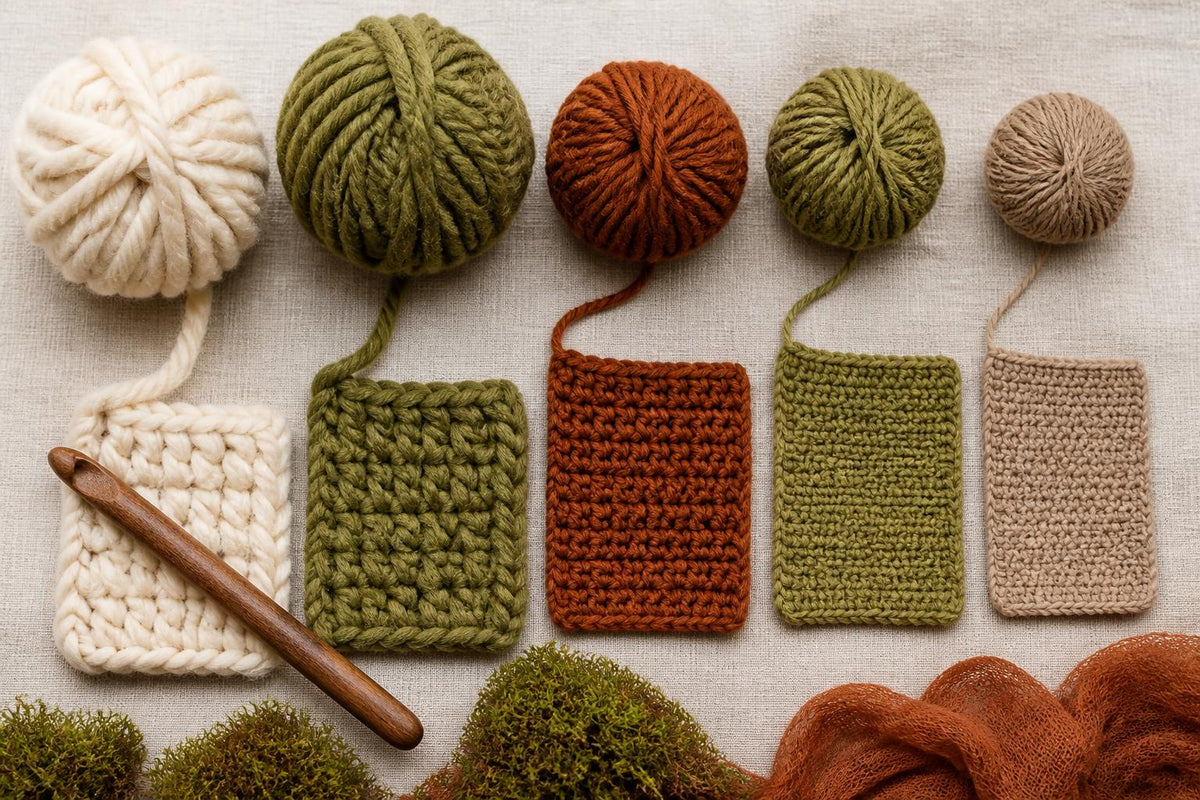
When people ask about crochet yarn sizes, they usually mean one practical thing, how thick the yarn is and what that means for the finished project. The important point is that yarn “size” is normally a weight category, not the actual weight of the ball in grams. A 100g ball can be fine 4 ply, chunky, or super chunky. What matters for crochet is the strand thickness, the metreage, the suggested hook range, and the fabric you want to make.
For UK crocheters, labels can be slightly confusing because yarn categories, ply names, metres per ball, and pattern language all sit together on the band. Once you know how to read those details, choosing between lace, DK, aran, chunky, or super chunky becomes much simpler. That helps you buy enough yarn, choose a sensible hook, and avoid a project that comes out stiff, floppy, too small, or far heavier than expected.
What crochet yarn sizes actually mean
In crochet, yarn size means the thickness category of the yarn. It does not mean the ball weight on the label. Two yarns may both be sold in 100g balls, but one could have 400 metres and the other only 80 metres. The first is much finer. The second is much thicker.
That is why metres matter so much. If you compare yarns by grams alone, you can end up substituting badly. If you compare by metres, category, and recommended hook size, you are much closer to a useful match.
You will also see older naming systems such as 4 ply, DK, aran and chunky. In the UK these names are still widely used, often more than the numbered systems found on some international labels. They are helpful, but not perfect. One brand’s DK can sit at the finer or fuller end of that category, so it is still worth checking the metreage and tension information.
Patterns can add another layer. A UK pattern may specify a yarn weight in words, a fibre type, and a hook size, then give a tension instruction. If the pattern is written in UK crochet terms, make sure you are not only matching the yarn, but also reading the stitches correctly. A UK treble is not the same stitch as a US double crochet, so stitch language and yarn choice work together.
On a yarn band, the most useful details are usually:
- fibre content
- ball weight in grams
- length in metres
- suggested hook or needle size
- care symbols
- tension guidance, if given
- colour reference and dye lot
If you are choosing without a pattern, metres per 100g is often the quickest way to place a yarn roughly in the right family. A yarn with very low metreage for its weight is generally thicker. A yarn with high metreage for its weight is generally finer.
How the main yarn sizes compare in practice
The common yarn size groups run from very fine lace yarns through to very thick super chunky yarns. Each behaves differently in crochet because crochet creates a denser fabric than knitting.
Lace and 4 ply sit at the fine end. These yarns suit delicate shawls, light garments, decorative edgings, and projects where drape matters. They can produce beautiful stitch detail, but they ask for concentration. Beginners often find them slow to work with because stitches are smaller, rows take longer, and counting matters more.
DK is one of the most approachable starting points. It is widely used for garments, blankets, accessories, toys, and homewares. The fabric can be light or structured depending on hook choice and stitch pattern. For many learners, DK is thick enough to see clearly but not so thick that mistakes become bulky and awkward.
Aran is fuller and often works well for hats, scarves, textured blankets, and practical accessories. It gives visible stitch definition, grows faster than DK, and usually feels manageable in the hand. If you want something substantial without moving into very heavy fabric, aran is often a good middle ground.
Chunky yarn moves projects along quickly. It is useful for baskets, cushions, winter accessories, and bold textured pieces. Crochet in chunky yarn can become firm quite quickly, especially if the hook is too small, so it is worth checking the drape before committing to a garment or blanket.
Super chunky is the thickest commonly used category for everyday crochet projects. It creates fast results and strong visual texture. It suits quick cowls, oversized hats, simple blankets, and statement accessories. It can also be ideal when you want a project to feel achievable over a weekend. The trade-off is that it uses more yarn by volume, can become heavy, and is less forgiving if the fabric turns too stiff.
For beginners, the practical expectations are fairly simple:
- fine yarns show detail but take longer
- mid-weight yarns such as DK and aran are often the easiest to learn with
- thicker yarns work up quickly but can become rigid if hook and stitch are not balanced
If you are choosing a first project, our guide to crochet projects that help beginners finish their first make can help you pair project type with a realistic yarn choice.
How to match yarn size to hook size and tension
Hook size is not a fixed rule attached to one yarn category. It is a starting point. The label might suggest a hook range, but your stitch style, the project type, and the fibre all affect what actually works best.
A larger hook usually gives more drape, more open stitches, and a softer fabric. A smaller hook usually gives a firmer, denser result with tighter stitch definition. Neither is automatically right. A market bag in cotton may benefit from firmness. A shawl usually needs flow. A basket may need structure. A baby blanket usually wants softness without gaping holes.
Crocheters also differ in natural tension. Some make very tight stitches, others very loose ones. That is why the same yarn and hook can produce different sizes in different hands.
The most reliable way to judge this is to make a tension square before starting. A tension square is not just about counting stitches for garment sizing. It tells you whether the fabric feels right. Work a decent sample, wash or steam it if that is how you will treat the finished item, then look at it honestly.
Check:
- does it drape or stand up on its own
- can you see too much through the stitches
- does it feel stiff
- does it feel heavy
- is the texture pleasant against the skin
- are the stitch repeats clear
For wearables, a tension square is essential. For blankets, it is still useful because a small difference in stitch size can change the final dimensions and yarn quantity quite a lot. For toys, bags, and baskets, it helps you decide whether stuffing will show through or whether the sides will hold shape.
If you are substituting yarn, compare three things together:
- metres per ball or skein
- stated yarn category
- the fabric produced in your own sample
Do not rely on hook size alone. Two yarns may both suggest a 6mm hook but behave very differently in crochet.
How fibre changes the feel of the same yarn size
Two yarns in the same size category can produce noticeably different results because fibre changes elasticity, warmth, stitch definition, and care requirements.
Merino is a good example. A super chunky merino yarn often feels springy, soft, and warm. The elasticity can make stitches sit neatly and recover well after handling. That softness is one reason many crocheters like it for accessories worn close to the skin. At the same time, merino can bloom slightly, softening very crisp stitch edges compared with a harder-spun fibre.
Standard wool and wool blends can vary a great deal. Some feel rustic and grippy, which is useful for colourwork or textured crochet that should hold shape. Others are softer and more relaxed. A blend may improve durability or change washing requirements.
Cotton behaves differently again. At the same stated size, cotton usually has less stretch than wool. It can feel cooler, clearer in stitch definition, and often heavier in the finished fabric. That can be excellent for dishcloths, bags, summer tops, and homewares, but less ideal for projects that need bounce. If you are comparing fibres for warmer-weather crochet, our article on choosing cotton yarn for crochet in the UK goes into that in more detail.
Acrylic is often chosen for easy care, colour range, and budget control. Depending on how it is spun, it may feel smooth, fluffy, firm, or soft. It can be a practical option for blankets and everyday makes, but it does not behave exactly like wool at the same yarn size. Some acrylics have less memory, some can squeak slightly on the hook, and some can lose stitch definition if they are very fuzzy.
This is where labels help, but swatching helps more. If a pattern calls for a woolly, elastic yarn and you substitute a dense cotton at the same nominal size, the project can grow heavier, less stretchy, and smaller or larger than expected depending on your tension. Matching category alone is not enough.
Care also matters. In the UK, care instructions on textile products are standardised, but fibre behaviour still differs brand to brand. Always follow the specific label guidance for washing and drying. If you are making for a child, gifting a blanket, or planning frequent washing, choose with that end use in mind from the start.
How much yarn to buy without guessing
The safest way to estimate yarn is by metreage, not by number of balls. Pattern requirements are usually given in metres or in a stated number of balls of a named yarn. If you are using the exact yarn, buying the specified number is straightforward. If you are substituting, convert the requirement into total metres and compare like with like.
For example, if a pattern needs 600 metres of a DK yarn, you need to know how many metres are in each ball of your chosen substitute. Ball weight alone will not tell you.
A few practical rules help:
- buy to the pattern metreage, then allow extra for swatching
- add a margin for borders, sleeves, length changes, or matching stripes
- allow more if your stitch pattern is dense or highly textured
- check whether the pattern repeat creates waste or partial motifs
- keep all labels until the project is finished
A swatch is useful here too. If you make a tension square and weigh it, you can estimate total yarn use more accurately for blankets and simple garments. This is especially helpful when you are designing your own project or adjusting dimensions.
Always check the dye lot before buying multiple balls for one project. Colours that look identical on screen or in a basket may come from different production runs. In hand, that can show as slight variation across a blanket or garment. For a single project, we recommend using one dye lot wherever possible. If you must combine lots, alternate balls across rows or rounds to blend the transition.
Be particularly careful when substituting across fibre types or thicknesses. A project written for a lofty woollen yarn may need more or less length if worked in a denser cotton or a flatter acrylic, even when the category sounds similar. That is one reason we prefer cautious planning over optimistic guessing.
If budget matters as much as quantity, our article on spending less on crochet yarn without false economy covers where it makes sense to economise and where it usually does not.
Choosing a practical starting point for UK projects
For most UK crocheters, the best starting point depends on the project, not on an abstract “best” yarn size. If you want to learn stitches clearly and make something useful, DK or aran are often the easiest places to begin. If you want a quick win, chunky or super chunky can be satisfying, provided you understand that the fabric may become dense and the project physically larger quite fast.
For simple hats, scarves, cowls, and quick home accessories, super chunky can be a very practical choice. It is easy to track your progress, easier to see stitch placement than with very fine yarn, and realistic for a short project window. That is one reason many people come to us looking for thick yarns first.
At Native Yarns, operated by Fleeta Limited, our verified retail range is World of Wool Chubbs in multiple colourways. This is a super chunky merino yarn, and it is particularly useful to discuss because it shows what thick, soft wool can do in practice. Compared with a firmer synthetic or a heavy cotton of similar size, a super chunky merino yarn is usually warmer, softer in the hand, and more elastic. That makes it a strong candidate for cowls, hats, simple scarves, and quick comfort projects where softness matters.
It is still worth being realistic. Super chunky yarn is not automatically the right answer for every beginner project. A large blanket in very thick yarn can become heavy and use a substantial quantity of fibre. Fine shaping in garments can be less subtle. Dense stitch patterns can feel bulky. So we suggest choosing it where speed, texture, and warmth are part of the goal.
If you are comparing thicker yarns for structure rather than softness, our piece on choosing chunky yarn for crochet that holds its shape may help you decide whether your project needs bounce, firmness, or both.
For many UK projects, a sensible shorthand looks like this:
- garments with drape, DK or 4 ply
- practical hats and scarves, aran to chunky
- baskets and structured homewares, chunky with a firm hook choice
- fast winter accessories, super chunky
- warm, soft statement pieces, super chunky merino
The simplest way to make better choices with crochet yarn sizes is to read the label in full, compare metres rather than grams, swatch before committing, and think about fibre as well as thickness. Once you do that, yarn categories stop feeling vague and start becoming useful tools. That is when project planning gets easier, substitutions get safer, and the finished crochet behaves much more like you intended.
Is yarn size the same as the weight of the ball?
No. Yarn size usually means the thickness category of the yarn, not whether the ball weighs 50g or 100g. Check the label for metres, fibre content and tension guidance as well.
What is the easiest crochet yarn size for beginners?
Many beginners find medium to thicker yarns easier to see and count. A smooth yarn with clear stitch definition is often simpler than very fine, fluffy or highly textured options.
Can I swap one yarn size for another in a pattern?
Usually only with care. Changing yarn size alters the finished measurements, drape and yarn quantity. Make a tension square first and compare the fabric, not just the label.
Why does the same yarn size look different between brands?
Weight categories are broad. Fibre, twist, loft and construction all affect how thick a yarn feels and how it behaves once crocheted, even when two labels use the same size name.
Why does dye lot matter for crochet projects?
Small colour differences can appear between production batches. If your project needs a consistent shade, buy enough from one dye lot before you start.