
How to choose chunky yarn for crochet that holds its shape
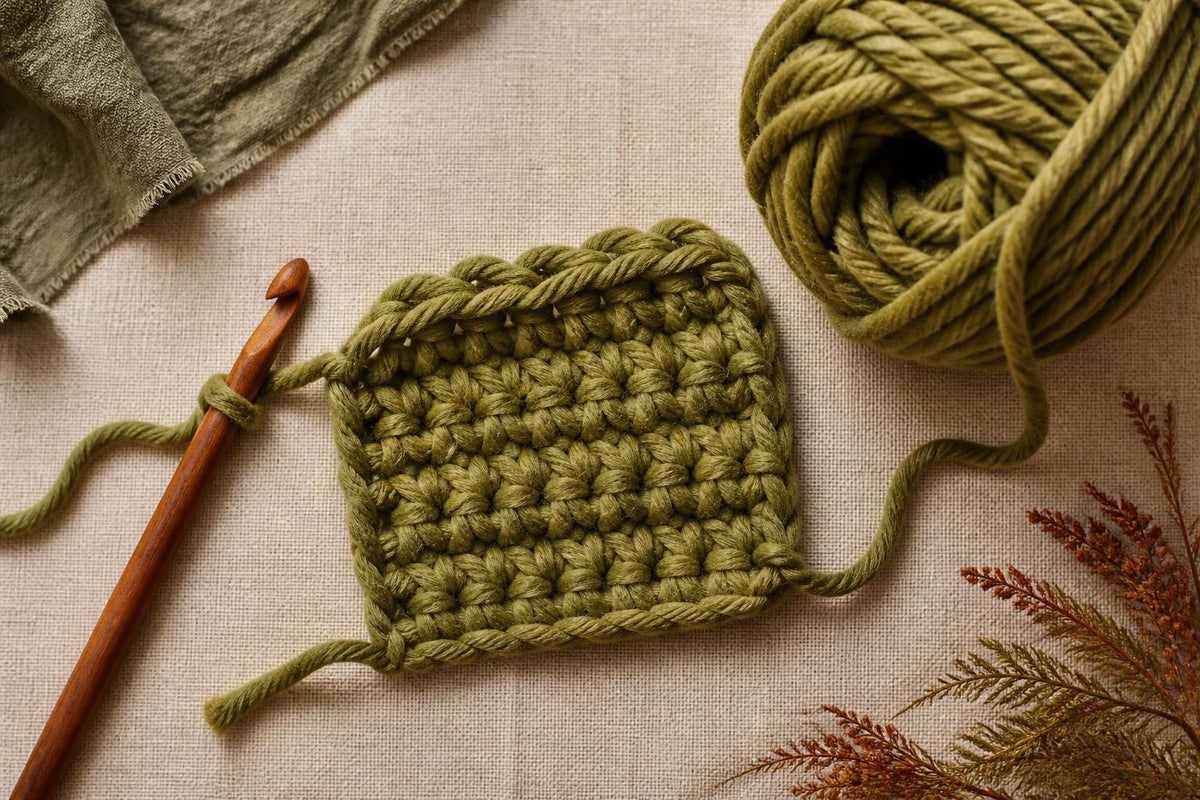
If you want crochet that keeps its structure, start with the fibre and the yarn weight, not the colour chart. A chunky yarn can look substantial in the skein and still work up into a fabric that slumps, stretches or pills too quickly. For baskets, cushions, hats with body, and garments that need clear stitch definition, the best choice is usually a yarn with enough loft and bounce to spring back after handling.
That is where chunky crochet yarn needs a closer look. In practice, shape comes from several things working together, the thickness of the yarn, the fibre, the twist, the hook size, and the stitch pattern. If one of those is out of step with the others, even a beautiful yarn can give you a fabric that feels too loose or heavy. Here is how we assess it before buying, and before starting a project.
What counts as chunky crochet yarn in the UK?
In the UK, yarn weight names are useful, but they are not perfectly standard across every brand. In broad terms, chunky sits above aran and below super chunky. If you are shopping from a UK pattern or yarn range, that is the first distinction to make.
For UK readers, chunky usually means a yarn that crochets into a firm, visible fabric on a medium to large hook. Super chunky is the next step up, noticeably thicker, faster to work, and better suited to bold texture and simple shapes. If you are comparing UK and US labelling, this is where confusion often starts. A UK chunky yarn may correspond roughly to what many US patterns call bulky, while UK super chunky often aligns with super bulky in US wording. Not every manufacturer uses those terms in exactly the same way, so the label alone is not enough.
The practical checks are better than the name on the band:
- Look at the recommended hook size.
- Check the metreage against the weight of the ball or skein.
- Read the tension information if it is provided.
- Compare the yarn to the pattern’s stated weight, not just its title.
A pattern that says chunky in a UK publication may not behave like a US pattern written for bulky yarn, especially if the designer has used a denser stitch pattern or a smaller hook for structure. The reverse is also true. A US pattern translated loosely into UK selling terms can leave you with a fabric that is much floppier than intended.
This matters because when people ask for chunky crochet yarn that holds its shape, they are usually not asking for thickness alone. They want thickness with enough resilience to support the stitches. That is why we always suggest reading the pattern details alongside the yarn details, rather than treating chunky, bulky and super bulky as exact equivalents.
If you are working with very thick yarn for the first time, our guide to super chunky wool yarn for UK projects explains how those labels translate into real project choices.
How fibre changes the result
Fibre decides far more than softness. It affects stitch definition, warmth, bounce, durability, weight in the finished fabric, and how much care the item will need after you have made it.
Merino is often chosen because it feels soft against the skin and has natural elasticity. That elasticity is one of the reasons it can be such a good choice for crochet that needs shape. The stitches have some spring, so ribbed hats, cowls, simple baskets, and textured accessories tend to look full rather than flat. Merino also gives a warm, breathable fabric, which is useful for winter wear and home accessories.
Compared with standard wool, merino is usually softer and more comfortable for sensitive skin. Compared with cotton, it is lighter in feel for the warmth it gives, and it has much more bounce. Cotton can produce excellent stitch definition, but in chunky and super chunky weights it can become heavy quickly. That extra weight can pull a crocheted piece down over time, especially in larger bags, oversized garments or storage pieces.
Acrylic is often durable and easy to wash, and it can be useful where low-maintenance care is the priority. But the feel and behaviour vary a great deal. Some acrylic yarns have less spring than wool, and some can lose the crispness of textured stitches once the fabric is handled repeatedly. Blends can improve this, depending on the mix.
Alpaca is warm and soft, but it is often drapier and less elastic than merino. That can be lovely in scarves and relaxed garments, but less helpful if your aim is structure. A super chunky alpaca-rich yarn may look generous and cosy, yet still collapse more than you expect in crochet.
So when we compare fibres in practical terms:
- For softness, merino is usually one of the easiest wins.
- For bounce and recovery, merino performs better than cotton and often better than alpaca.
- For crisp stitch definition, cotton can be very clear, but it may be heavier.
- For warmth without too much weight, merino is strong.
- For easy care, acrylic often has an advantage, though always check the label.
- For long-term structure, the right wool or wool-rich yarn often outperforms fibres with less elasticity.
Fibre also affects pilling and wear. A very soft yarn can sometimes show friction sooner on cuffs, underarms or bag handles. That does not make it a poor choice. It simply means matching it to the right project. A soft merino cowl and a heavily used market bag do not ask the same things of a yarn.
When super chunky merino is the right choice
There are projects where super chunky merino is exactly right, and projects where it is the wrong tool. We find it works best when you want speed, warmth, softness and visual impact in one go.
Our range centres on super chunky merino yarn in multiple colourways, specifically World of Wool Chubbs. This is the sort of yarn that suits fast makes, gifts, statement accessories and simple patterns where the yarn itself does much of the visual work. If you want to finish a hat, cowl, scarf or small home accessory in very little time, Chubbs makes sense.
Colour is part of that appeal. In very thick yarns, colour reads differently because the stitches are large and the surface area is more obvious. A simple half treble or double crochet fabric can look rich and sculptural in a way that finer yarns do not. That makes super chunky merino especially effective for uncluttered designs and clear stitch patterns.
Texture is another strength. Merino has a softness and bloom that can make crochet feel plush without becoming limp, provided the hook size and stitch choice are sensible. If you use too large a hook, even a lofty yarn can turn open and loose. If you use the right hook, the fabric can feel full and resilient.
The trade-offs are worth being clear about.
First, weight. Super chunky projects grow quickly, but they can also become physically heavy as they get larger. A cushion front or basket is one thing. A long cardigan in very thick yarn is another. The bigger the project, the more likely it is that gravity will affect drape and shape over time.
Second, drape. Super chunky merino is not usually the best choice for fluid garments. It shines in projects that benefit from body, not in pieces that need to skim and swing.
Third, care. Merino needs more careful washing and drying than many synthetic yarns. If the item is for everyday rough use, or for someone unlikely to follow wool care instructions, that matters.
For quick, satisfying makes, though, it is hard to beat. If you are choosing between project ideas, our round-up of fast crochet projects you can finish this weekend is a good place to start.
How to match yarn, hook and pattern without guesswork
The easiest way to lose shape in crochet is to substitute yarn casually and hope for the best. You can avoid most problems by checking four things before you start, yarn weight, metreage, hook size, and tension.
Begin with the pattern. Look for:
- the stated yarn weight
- the total metreage required
- the recommended hook size
- the tension information
- whether the pattern uses UK crochet terms or US terms
This last point matters a great deal. In UK crochet terms, a double crochet is not the same stitch as a US double crochet. If you use the wrong terminology system, your fabric, sizing and yarn usage can all be wrong before you are ten rows in.
Then compare the yarn band. If a pattern calls for chunky and your chosen yarn is super chunky, the hook size recommendation will usually tell you immediately that the substitution is significant. Sometimes that can still work, but only if you are deliberately changing the scale and are prepared to recalculate.
The tension square is the step many crocheters skip, and it is the one that saves the most frustration. Work a proper tension square in the stated stitch pattern, using the hook you think is right. Measure the stitches and rows over the area specified by the pattern. If your square is too large, your hook is probably too big. If it is too small, your hook is probably too small.
Do not rely on the ball band tension alone. Ball band tension is a general guide, often based on a standard stitch and technique. Your own crochet tension may be tighter or looser, and a textured stitch pattern can alter the fabric dramatically.
For shape retention:
- Use a smaller hook if you need a firmer fabric, but only within reason.
- Choose simpler stitches for very thick yarns if you want structure.
- Remember that openwork increases drape, even in a lofty fibre.
- Check how the fabric behaves when held up, not just when laid flat.
For example, a super chunky merino yarn worked in tight double crochet can make a sturdy basket-like fabric for a small project. The same yarn worked in trebles on a large hook may produce a soft, airy cowl. Neither is wrong, but they are not interchangeable.
If you are just getting comfortable with matching tools to yarn, our guide to a first crochet set that you’ll use covers the basics of choosing hooks and other essentials sensibly.
How much yarn do you need?
The shortest answer is this, buy by metreage, not by ball count alone.
A pattern that says “3 balls” is only useful if your balls match the original yarn in weight and length. Two super chunky yarns can both come in 100g units and still offer very different metreage. If you substitute one for the other based only on the number of balls, you can easily run short or overbuy.
To estimate yarn for crochet, check these factors first:
- total metres required by the pattern
- the yarn weight category
- the fibre content
- the stitch pattern
- the finished dimensions
Stitch pattern changes yarn use more than many people expect. Dense stitches such as double crochet use yarn differently from lacier stitches. Texture, cables, bobbles and deep ribbing can all increase consumption. Crochet also tends to use more yarn than knitting for the same area of fabric, because the structure of the stitches is different.
As a practical guide, small accessories in super chunky merino often need less yarn than people fear, while garments and blankets need more than people first assume. Hats, cowls and baby accessories can be quite economical because they are compact. Throws, long scarves and oversized jumpers add up quickly because each row covers a lot of volume.
Fibre matters too. A bouncy woollen yarn may fill space differently from a denser cotton yarn, even at the same nominal weight. That affects both coverage and drape.
When we plan a project, we usually work like this:
- Start with the pattern’s stated total metres.
- Compare that with the metreage per ball or skein of the chosen yarn.
- Add a margin for swatching, especially if colour placement matters.
- Add extra if the project is size-adjustable or if you may lengthen sleeves, body or borders.
If you are designing your own project rather than following a pattern, weigh your swatch after making the tension square, then calculate from the area of the finished piece. It takes a little more time, but it is the most reliable way to estimate for crochet.
What to check before you buy and how to care for it
Before buying yarn online, there are a few checks that make the difference between a smooth project and an irritating one.
First, check the fibre content and the yarn weight carefully. Product photography can make a yarn look denser, fluffier or smoother than it feels in real life. Read the description for the actual material and intended use.
Second, check the metreage, not just the unit weight. This is especially important if you are comparing different brands or trying to substitute from a pattern.
Third, if you need more than one skein for the project, buy enough in one order where possible and check the dye lot when it arrives. A dye lot identifies yarn produced in the same dye batch. Even with careful manufacturing, slight colour variation can happen between batches. In a striped project this may not matter much. In a plain garment front, it can be obvious.
For online buying, realistic checks include:
- comparing the listed fibre and weight with your pattern
- reading whether the yarn is sold in balls, skeins or hanks
- checking colour names across the whole project before ordering
- ordering enough at once to reduce the chance of mixed dye lot numbers
- looking closely at product images in natural-looking light, while remembering screen colour varies
Where rules differ, there is not usually a yarn-labelling divide between the UK and the EU that affects ordinary project planning in a major way, but terminology and retail presentation can vary by brand and market. The practical checks above are more reliable than assuming two products labelled similarly will behave the same way.
Once your project is made, care is what keeps the shape you worked for.
With merino, gentle handling matters. Always check the care instructions provided for the yarn. In general, hand washing in cool or lukewarm water with a wool-appropriate cleanser is the safest option for handmade crochet. Avoid hot water, vigorous rubbing and sudden temperature changes, all of which can encourage felting or distortion.
After washing:
- support the item fully when lifting it
- press out water without wringing
- reshape it while damp
- dry it flat on a clean towel or drying surface
- keep it away from direct heat
Storage matters too. Clean items before storing them for a season, and keep them dry, folded and protected from moths. Hanging heavy crochet, especially in super chunky fibres, can stretch it out of shape. Folded storage is usually better for preserving structure.
If you are choosing a thick yarn specifically because you want crochet to hold its shape, the decision is never about thickness alone. It is about the balance between yarn weight, fibre, hook size, stitch pattern and care. For many UK crochet projects, a well-chosen merino in a true super chunky weight gives that balance beautifully, especially when the project is simple enough to let the yarn do its job.
For readers exploring options, we keep our focus on carefully chosen yarns, including World of Wool Chubbs, and on practical guidance that helps you use them well. That is usually the difference between a project that only looks good in the skein, and one that still looks right after it has been worn, used and enjoyed.
Is chunky the same as super chunky?
No. super chunky is thicker than chunky, so it works up faster and creates a heavier fabric. Always check the pattern wording, recommended hook size and metreage rather than relying on the name alone.
Is merino good for crochet?
Yes, merino is valued for softness, warmth and elasticity. It can be especially appealing for cosy crochet, but it may need gentler care than harder-wearing fibres and can produce a denser fabric in thicker weights.
Why do I need a tension square for crochet?
A tension square shows whether your stitches match the pattern's gauge. With chunky yarn, small differences in hook size or stitch tension can change the finished size and yarn quantity quite noticeably.
Can I swap a pattern from US to UK crochet terms?
Only if you convert the stitches carefully. UK crochet terms and US terms use some of the same words for different stitches, so check the pattern key before you begin.
Should all my yarn come from the same dye lot?
Ideally, yes. Using the same dye lot helps keep colour consistent across a project. If you must mix lots, alternate balls across rows or rounds to soften visible changes.