
How to choose a first crochet set that you’ll use
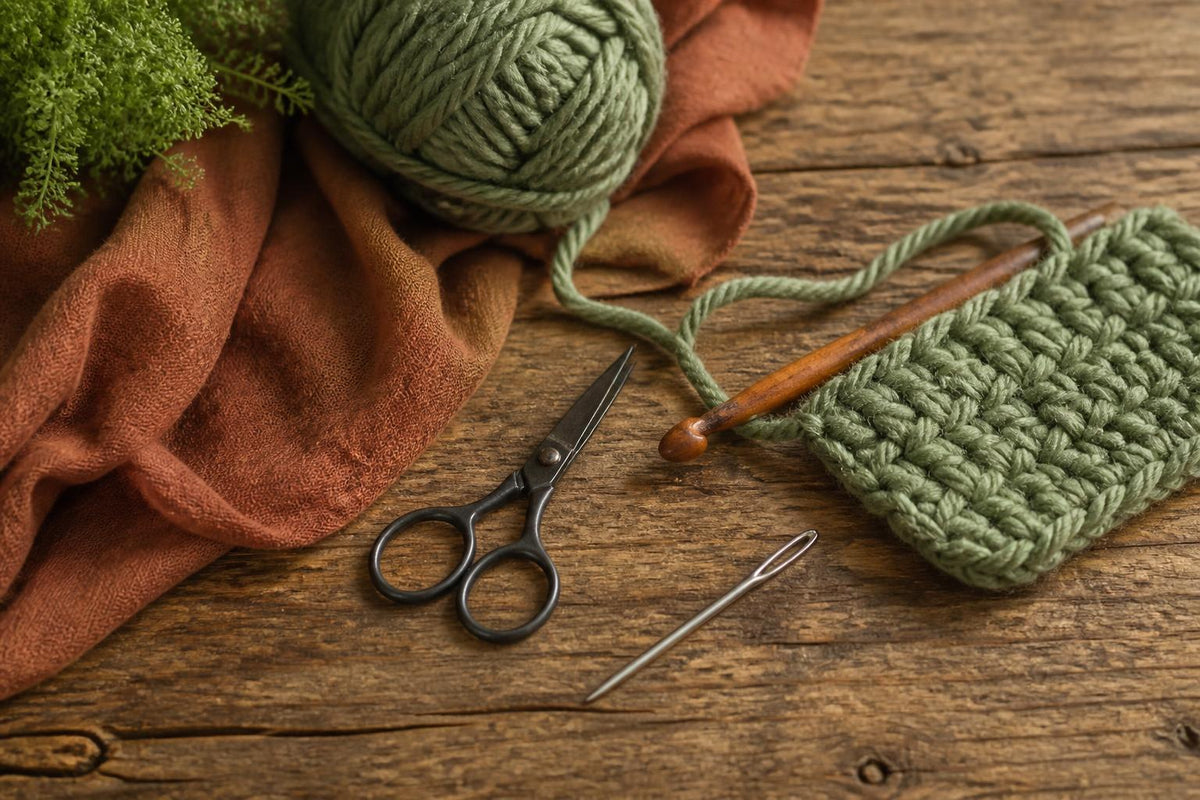
Choosing a first crochet kit is mostly about removing avoidable frustrations. A useful first set is not the one with the most pieces, it is the one that gives you a hook you can hold comfortably, a yarn that lets you see each stitch, and just enough tools to start and finish a simple project. If your materials fight each other, learning feels harder than it is.
For most beginners, a good beginner crochet set means one or two hooks in sensible sizes, a smooth light-coloured yarn, a pair of scissors, a blunt yarn needle, and a few stitch markers. Everything else can wait until you know what you enjoy making. We find that people get on better when they choose materials deliberately, rather than buying a large bundle of mixed tools and novelty yarns that look generous but do not work well together.
What a beginner really needs in a first crochet set
The essentials are surprisingly few.
First, you need a crochet hook in a size that matches the yarn you plan to use. For a first project, that usually means a mid-range hook rather than an extremely fine or very large one. In practical terms, many beginners learn comfortably with hooks around 4 mm to 6 mm, depending on the yarn. If you are using thicker yarn, you may go larger.
Second, you need yarn that shows stitch definition clearly. Smooth yarn is easier than fluffy, hairy, heavily slubbed, or very dark yarn. A pale or mid-tone shade helps you see where to insert the hook and count stitches accurately.
Third, you need basic finishing tools. A small pair of scissors and a blunt tapestry or darning needle for sewing in ends are enough to complete a first swatch, dishcloth, scarf, or simple cowl.
Fourth, a few stitch markers are genuinely useful. They do not need to be expensive or decorative. Their job is to mark the first or last stitch in a row or round, which helps prevent accidental increases and decreases. For a beginner, that is one of the most common causes of wonky edges.
That is the core of a sensible first set.
What sits in the nice-to-have category? Measuring tape, row counter, project bag, hook case, blocking mats, extra notions, ergonomic handle sets with many duplicate sizes, and specialist tools for amigurumi, Tunisian crochet, or lacework. These are all helpful once you know you need them, but they are not necessary on day one.
The same goes for large boxed kits. Some are well assembled, but many include tiny hooks, multiple yarn types, and accessories you will not use yet. When we talk about choosing a first set that you will actually use, we mean choosing fewer things that work well together.
If you are building your own set, think in this order:
- Pick the yarn.
- Check the recommended hook size on the yarn band.
- Add scissors, a yarn needle, and markers.
- Buy only the quantity needed for your first project, plus a little margin if you are still practising tension.
That approach is usually more useful than buying tools first and trying to fit yarn around them later.
How to match hook size, yarn weight and UK crochet terms
A lot of early confusion comes from three systems overlapping at once, yarn weight names, metric hook sizes, and stitch terminology.
In the UK, hook sizes are normally given in millimetres. That is the clearest system, and the one we recommend following. A 4 mm hook is a 4 mm hook, regardless of brand. Older UK hook numbering systems still appear occasionally in vintage patterns, but metric sizing is the practical standard when buying tools now.
Yarn weight names describe thickness categories rather than exact measurements. You will see names such as 4 ply, DK, aran, chunky, and super chunky. These categories are useful, but the yarn band matters more than the category name alone, because recommended hook sizes can vary between fibres and constructions.
If you are comparing options, a yarn sold as DK yarn will usually need a smaller hook than a yarn sold as super chunky yarn. That sounds obvious, but it matters because beginners often buy a hook set and then assume any hook will do with any yarn. It will not. A mismatch makes stitches either cramped and hard to insert into, or loose and shapeless.
The yarn band is your starting point. It usually gives:
- fibre content
- ball weight and metreage
- recommended hook or needle size
- care instructions
- tension information
For crochet, the recommended hook size is guidance, not law. If your stitches are very tight, you may need to go up a size. If they are very loose, you may need to go down. But the band gives you the sensible place to begin.
Then there are UK crochet terms. This catches out many learners because a pattern written in UK crochet terms uses stitch names differently from a US pattern. The stitches themselves are not different, the names are.
For example:
- UK double crochet equals US single crochet
- UK treble crochet equals US double crochet
- UK half treble crochet equals US half double crochet
That means a pattern calling for “dc” can mean different stitches depending on whether it is written in UK or US terminology. Before you buy yarn or start a project, check the pattern notes. A good pattern will say explicitly whether it uses UK crochet terms or US terms.
This matters when choosing your first project because stitch height affects fabric density, drape, and yarn usage. If you think you are making one stitch but the pattern means another, your tension, size, and yarn consumption can all end up wrong.
A simple habit helps. Before starting, look at three things together:
- the stated terminology, UK or US
- the recommended yarn weight
- the hook size in millimetres
If all three make sense together, you are probably set up correctly.
Which yarn makes learning easier
The easiest yarn for learning is usually smooth, plied, medium to light in colour, and not too thin. You want to see each stitch clearly and feel where the hook should go.
Fibre matters, but texture matters more at the very beginning. A soft wool or wool blend can be lovely to work with, but if it is fuzzy, haloed, or loosely spun, it can hide the stitch structure. Likewise, chenille can feel appealing but is often difficult for beginners because the stitches disappear into the pile and mistakes are harder to spot.
For learning, we suggest looking for:
- smooth texture
- clear stitch definition
- a colour that is not black, navy, or very mottled
- a thickness that works up quickly enough to keep practice encouraging
Acrylic is often recommended for absolute beginners because it is affordable and widely available. Cotton can also be good, especially for dishcloths, because the stitch definition is crisp. Wool, including merino, can be excellent when it is smooth and not overly splitty, though beginners may prefer to practise first on a yarn where unpicking feels less precious.
Colour deserves more attention than it usually gets. Dark shades absorb light and make it harder to count stitches. Highly variegated shades can also disguise stitch placement. A solid cream, soft grey, muted blue, or other clear mid-tone often makes learning easier. If you are choosing with gift-making in mind as well, our yarn colour palette inspiration can help you think about combinations once the basics feel comfortable.
Thickness is a balance. Very fine yarn can feel slow and fiddly. Very thick yarn can be satisfying because progress is fast, but oversized stitches can make it harder to learn precise insertion points if the yarn is very lofty. Many beginners enjoy a middle ground such as DK or aran for technique practice, then move into thicker yarns for quick projects.
If your aim is early success, choose yarn that forgives you. That means it should be easy to frog, or unravel, without felting, snagging, or shedding. Learning crochet involves making and correcting mistakes. A yarn that resists that process can make a calm afternoon turn into a battle.
What to check before buying a project quantity
Once you move beyond a practice swatch, the next question is how much yarn to buy. This is where a little planning saves annoyance later.
Start with the pattern, if you are using one. It should tell you the yarn weight, total quantity, and often the metreage used for each size. Metreage is more reliable than ball count because balls come in different weights and lengths. Two yarns can both be sold in 100 g balls but contain very different numbers of metres depending on fibre and construction.
If you are not using a pattern, estimate by project type. A small practice piece or simple headband needs little yarn. A scarf, hat, or cowl needs more. A blanket needs much more, and consistency becomes more important.
Before committing to a project quantity, make a tension square. This is worth doing even for beginners, especially if the project size matters. A tension square tells you how your own crochet compares to the pattern gauge. If your stitches are tighter than the designer’s, you may need more yarn. If they are looser, you may use less, but your finished piece may also come out too large or too drapey.
A proper tension square should be larger than the measured area, so you can measure the centre without edge distortion. Work it in the stated stitch pattern, not just in any stitch you fancy. Then measure according to the pattern instructions, usually over 10 cm. If the gauge is off, adjust hook size and try again.
Beginners sometimes skip this because it feels like a delay. In reality, it is often the quickest way to avoid remaking a garment or running short near the end.
Also check the dye lot. This is especially important when buying more than one ball for the same project. The dye lot identifies a batch of yarn dyed together. Even when the colour name is the same, yarn from different batches can vary slightly. In a striped or highly textured piece that may not matter much, but in a large plain project the shift can be visible.
In the UK, as in the EU generally, dye lot consistency is a practical purchasing issue rather than a legal promise that every batch will be visually identical. When buying a project quantity, we recommend getting all the yarn you need at the same time where possible, and checking that the dye lot matches across the balls if the yarn is batch dyed.
If you think you may need extra, buy it before you start rather than hoping it will still be available later in the same batch. That is particularly relevant for blankets, garments, and larger accessories.
For quick early wins, smaller projects are often the best use of a first set. If you want ideas that let you practise without committing to a huge yarn quantity, have a look at fast crochet projects you can finish this weekend.
A sensible first setup from Native Yarns context
At Native Yarns, operated by Fleeta Limited, our verified retail yarn range is currently centred on World of Wool Chubbs super chunky merino. That matters because the best first setup depends partly on what is actually in front of you, not an imaginary shop with every weight and fibre in stock.
So where does World of Wool Chubbs fit for a beginner?
Chubbs is a super chunky merino yarn. That makes it relevant for beginners who want fast visual progress, bold stitch definition, and a project that grows quickly in the hand. Those qualities can be very encouraging. A thick, smooth yarn can help you understand the structure of chains and basic stitches more quickly than a very fine yarn.
Our super chunky merino yarn collection is therefore a sensible place to look if your priority is speed, warmth, and visible texture. It can suit simple scarves, cowls, and straightforward home accessories where exact shaping is limited and the pleasure comes from seeing crochet build rapidly.
That said, educational comparison matters here. A super chunky merino yarn is not automatically the universal best teaching yarn for every beginner and every project. Before purchase, check a few things.
First, check the pattern or learning resource you plan to use. If it was written for DK or aran yarn, substituting Chubbs may change the scale dramatically. Stitches will be larger, fabric denser or loftier depending on hook choice, and yarn usage will differ. Not every beginner pattern translates neatly to super chunky.
Second, check the hook size in millimetres recommended for the yarn and compare it with the hook used in your tutorial or pattern. If a video demonstrates technique with a smaller hook and thinner yarn, the hand movements still transfer, but the look and feel of the fabric may not.
Third, consider the kind of practice you want. If you are learning chains, rows, and basic stitch recognition, a thick yarn can be excellent. If you want to learn fine shaping, delicate lace, or detailed amigurumi, you may prefer to compare with other yarn weights educationally before deciding what to buy. We may discuss those alternatives in our journal, but unless a product is listed in our shop, you should not assume we stock it.
Fourth, think about quantity. Super chunky projects can use up ball yardage quickly because the yarn is thick, even though the project grows fast. That makes checking metreage and working a tension square especially important before buying for a larger item.
Finally, think about care and purpose. Merino is beautifully soft, but the right first project should match the yarn’s strengths. A cosy accessory is usually a more natural fit than an item that needs frequent hard washing or very crisp stitch structure.
A sensible first setup in our context might therefore be:
- one simple beginner-friendly pattern written for super chunky yarn
- the stated quantity of World of Wool Chubbs in one matching dye lot
- the recommended hook size in millimetres
- scissors
- a blunt yarn needle
- a few stitch markers
That is enough to learn properly and finish something useful.
The best first crochet set is the one that removes noise. Choose a hook that matches the yarn, choose yarn that lets you see what you are doing, and buy enough for one realistic first project. If you begin with clear materials rather than a crowded bundle of extras, you are far more likely to keep crocheting, and to use what you bought.