
A free chunky crochet hat pattern that fits first time
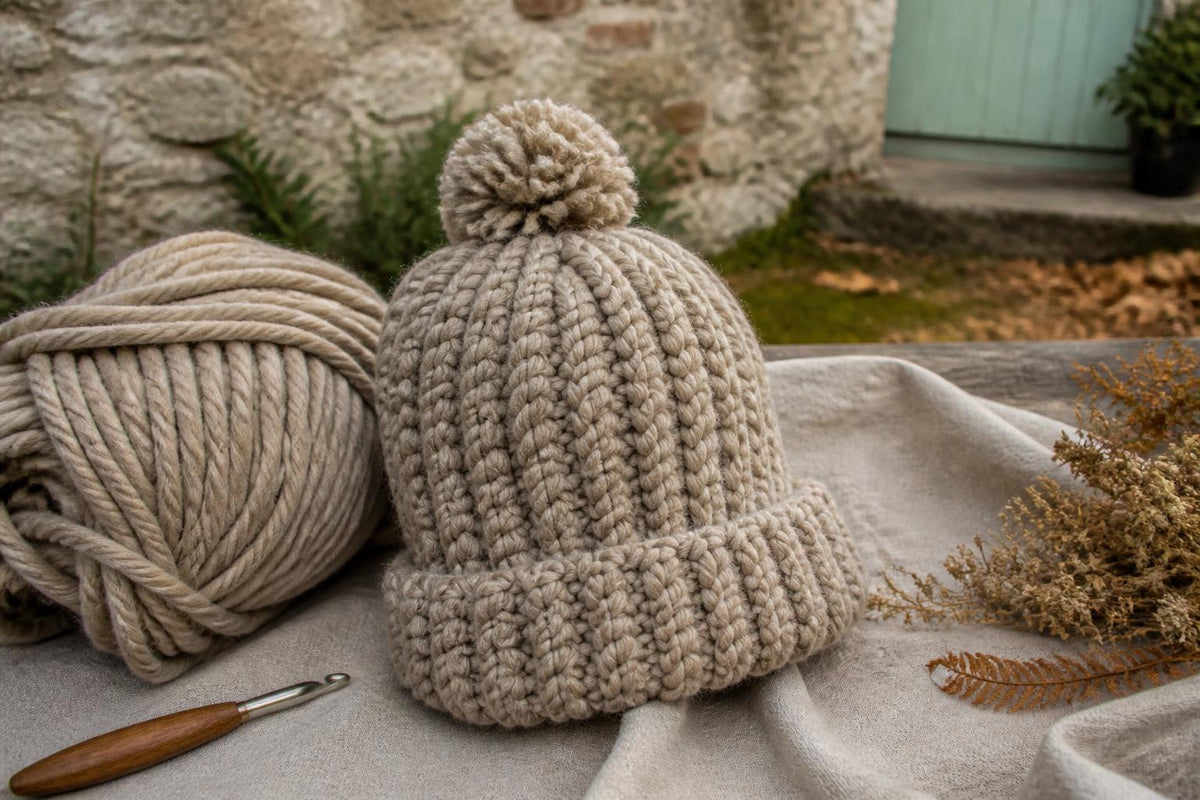
If you want a chunky crochet hat to fit first time, two things matter more than anything else. Start with a yarn that shows your stitches clearly and builds fabric quickly, then check your tension before you commit to the full hat. A simple crown increase, a straight body section and a measured final depth will get you much closer to a wearable result than guessing from the ball band alone.
A good free pattern should feel manageable from the first round. For many beginners, that means a hat worked in the round with one main stitch, clear repeat points and easy places to stop and measure. If you have been searching for a chunky yarn hat crochet pattern free of fussy shaping and hard-to-read instructions, that is exactly the sort of structure to look for.
What makes a chunky crochet hat pattern work well for beginners
The best beginner hat patterns are not necessarily the shortest. They are the clearest. A useful free pattern tells you where the crown increases stop, what the stitch count should be at that point, and how to check fit before you finish the top or brim. Those checkpoints matter more than decorative detail.
For a first hat, we would look for these features:
- one main stitch throughout most of the hat
- a crown increase sequence that follows a simple repeat
- stitch counts at the end of every increase round
- guidance for at least two sizes
- a note on finished measurements
- instructions written in either UK crochet terms or US terms, with no mixing
Super bulky projects are often recommended to beginners because they finish fast, but speed is only part of the story. A true super chunky yarn also makes it easier to read your fabric. You can see where each stitch begins and ends. That helps with counting, spotting mistakes and understanding how shaping works.
The other beginner advantage is motivation. A hat in super chunky yarn grows quickly enough that you can try it on within one sitting. That immediate feedback is useful. If the crown is too flat, too pointy, too wide or too shallow, you will know early enough to adjust.
Not every thick yarn behaves well in crochet, though. Some are lofty but split easily. Some have so little twist that beginners struggle to insert the hook cleanly. If you want more on choosing a yarn that works with the stitch rather than against it, our guide to choosing chunky crochet yarn that won’t fight your project covers the practical signs to look for.
How to choose yarn and hook size for a warm hat
For a warm hat, fibre matters as much as thickness. Acrylic can be practical and easy-care, cotton can feel cool and dense, but for a winter hat many crocheters choose wool because it balances warmth, breathability and elasticity. Within wool, merino is popular because it feels soft against the skin and usually gives a comfortable, springy fabric.
That is where World of Wool Chubbs comes into its own. Chubbs is a super chunky merino yarn, so you get the quick progress of a thick yarn with the softness many people want for hats, cowls and simple cold-weather accessories. If you want to browse colours and compare options directly, see our super chunky merino yarn collection.
When comparing yarns for a hat, check four things.
First, fibre. Pure wool and merino tend to trap warmth well and recover their shape better than many plant fibres. If the wearer is sensitive to texture, softness becomes even more important because a hat sits directly on the forehead and ears.
Second, thickness. Labels such as chunky and super chunky are useful, but they are not perfectly standard across all brands. One maker’s super chunky can feel denser or loftier than another’s. That is why the pattern gauge matters more than the category name on its own.
Third, stitch definition. For a plain hat, good stitch definition helps you count rounds and keep shaping tidy. Smooth singles and softly twisted yarns can both work, but if a yarn blooms heavily it may blur the stitch pattern.
Fourth, hook size. The hook on the ball band is a starting point, not a rule. For hats, many crocheters prefer a slightly firmer fabric than they would for a blanket, because a hat needs structure. If your stitches look open and floppy, go down a hook size. If the fabric feels stiff and the crown cups too sharply, go up a size.
With super chunky merino, a difference of just 1 mm can noticeably change the finished hat. That affects warmth too. A firm fabric blocks wind better, but if it becomes rigid the hat may not sit comfortably. We usually suggest making a small swatch with two nearby hook sizes before deciding.
If you are still comparing weight categories and want a broader overview, our guide to how to choose chunky yarn for crochet that holds its shape is a useful next step.
How much yarn do you need for a chunky hat?
For an average adult hat in super chunky yarn, one ball may be enough for a close-fitting beanie, but you should not assume that before checking the meterage on the label against the pattern requirement. Super chunky balls vary widely in length because fibre, spin and ball weight differ from brand to brand.
Yarn use increases quickly if you add any of the following:
- a deep folded brim
- extra slouch
- a large pom-pom
- textured stitches such as post stitches
- a matching cowl or wrist warmers
A folded brim is the feature that catches people out most often. Doubling the brim depth does not quite double the whole yarn requirement, but it adds more than many expect because brim fabric is dense and worked over the full circumference.
Pom-poms need a separate estimate too. A full yarn pom-pom can use a surprising amount, especially in super chunky wool. If you are close to the pattern minimum, keep the last part-ball aside until the hat is fully finished and measured.
For matching accessories, treat each item as its own project. Do not rely on leftover assumptions. A cowl in the same yarn can easily take as much again as the hat, depending on height and stitch pattern.
One practical point that matters on any multi-ball project is the dye lot. If your hat might need more than one ball, or if you are making matching pieces, buy enough at the start and check that the dye lot matches across all balls. Small shade differences can be visible in plain crochet, especially across a brim or crown.
Why a tension square matters even for a quick hat
A tension square feels like the part everyone wants to skip. For a fitted hat, it is the part that prevents disappointment.
In UK crochet terms, make your tension square in the main stitch pattern you plan to use for the hat. If the pattern body is dc in the round, work your swatch in dc. If the hat uses htr, swatch in htr. A square of at least 10 cm by 10 cm is much more useful than a tiny token sample because edge distortion affects small swatches too much.
To make one, chain enough stitches to give you more than 10 cm width. Work several rows in the chosen stitch until the height also exceeds 10 cm. Then lay the swatch flat without stretching it and measure the central 10 cm section. Count both stitches and rows.
For a hat, stitch gauge affects width and row or round gauge affects depth.
If your stitches are too large:
- the hat circumference will come out too wide
- the fabric may feel loose and draughty
- the crown may spread faster than intended
If your stitches are too tight:
- the hat may be too small around the head
- the fabric may feel stiff
- the hat can end up too short if your rounds are compressed
This matters even more with super chunky yarn because each stitch contributes a larger amount to the final measurement. Being out by only a few stitches over 10 cm can change the fit noticeably.
If you are following a pattern written in UK crochet terms, make sure you are not accidentally substituting US meanings. UK dc is US sc. UK tr is US dc. That single misunderstanding is enough to turn a fitted hat into something completely different. We explain the conversion clearly in our guide to UK and US crochet terms made simple for beginners.
A simple free hat pattern in UK crochet terms
This is our straightforward top-down beanie in UK crochet terms, designed for super chunky merino with clear checkpoints so you can adjust before the fit goes wrong.
Materials
- 1 to 2 balls of super chunky merino, depending on size and whether you want a folded brim or pom-pom
- 9 mm hook, or the hook needed to obtain a firm but flexible fabric
- stitch marker
- yarn needle
- tape measure
World of Wool Chubbs works well for this style because the fabric builds quickly and the stitch definition stays easy to read.
Sizes
Adult S-M, to fit approximately 54 to 57 cm head Adult M-L, to fit approximately 57 to 60 cm head
Because crochet fabric varies, use the diameter and depth checkpoints below rather than relying on size names alone.
Tension
In dc, 8 stitches and 9 rounds to 10 cm with 9 mm hook, measured after a light rest. If your tension differs, change hook size before starting the hat.
Notes
- Join each round with a ss unless you prefer working in a spiral.
- Ch 1 at the start of dc rounds does not count as a stitch.
- The hat is worked from crown to brim.
- UK crochet terms are used throughout.
Abbreviations
- ch chain
- dc double crochet
- ss slip stitch
- inc 2 dc in next stitch
Crown
Make a magic ring.
Round 1: Ch 1, 8 dc into ring. Join. 8 sts
Round 2: Ch 1, inc in each st around. Join. 16 sts
Round 3: Ch 1, 1 dc in next st, inc in next st, repeat around. Join. 24 sts
Round 4: Ch 1, 1 dc in each of next 2 sts, inc in next st, repeat around. Join. 32 sts
Round 5: Ch 1, 1 dc in each of next 3 sts, inc in next st, repeat around. Join. 40 sts
Round 6: Ch 1, 1 dc in each of next 4 sts, inc in next st, repeat around. Join. 48 sts
At this point, measure the crown diameter across the centre.
For Adult S-M, stop increasing when the crown measures about 16.5 to 17.5 cm. For Adult M-L, work one more increase round if needed.
Round 7 for larger size only: Ch 1, 1 dc in each of next 5 sts, inc in next st, repeat around. Join. 56 sts
A larger crown gives more circumference. If your yarn or tension is different, the measured diameter is the best guide.
Body
Work 1 dc in each stitch around until the hat measures:
- 18 cm from crown centre for a standard beanie
- 20 to 21 cm from crown centre for a turn-up brim
Try the hat on after a few body rounds. The sides should come down smoothly without flaring. If the hat feels too loose, go down a hook size for the remaining rounds or remove one increase round and try again. If it feels tight, add one increase round before continuing the body.
Brim options
Simple brim
Work 2 more rounds in dc. Fasten off, leaving a tail for weaving in.
Firmer brim
Change to a hook 1 mm smaller and work 2 to 3 rounds in dc. Fasten off.
Folded brim
Work 4 to 6 extra rounds in dc, depending on how deep you want the turn-up. Fasten off and fold brim to the outside.
Optional finishing round
For a neater edge, join yarn and work 1 round of ss loosely around the brim. Do not pull tight or the edge may pucker.
Pom-pom
If adding a pom-pom, make sure you have enough yarn left before attaching it. Secure firmly through the crown so it can be removed for washing if preferred.
This pattern is intentionally plain. Once the fit is right, you can adapt it with stripes, a ribbed brim worked separately, or a different body stitch. If you have been looking for a chunky yarn hat crochet pattern free of complicated shaping, this is the structure we recommend starting from.
How to finish, wash and store a chunky merino hat
Finishing is what turns a quick make into a hat that lasts.
Start by weaving in ends properly. With super chunky yarn, short tails can work loose, so leave a decent length when fastening off. Thread the tail through the backs of several stitches, change direction once, then trim neatly. Avoid cutting too close, especially on a frequently stretched edge like the brim.
If you used more than one ball, check the hat in good natural light before washing. A slight dye lot change can be easier to spot once the full shape is complete. It is much better to notice that before adding a pom-pom or sewing on any extras.
For washing, merino deserves a gentle approach. Unless the label states otherwise, hand wash in cool to lukewarm water with a wool-safe detergent. Do not rub, wring or shock the fibres with sudden temperature changes. In the UK, that advice is standard for wool care. If you are comparing guidance from EU sources, the fibre care principles are much the same, but always follow the specific label on the yarn you used.
After washing, press out excess water in a towel. Then reshape the hat and dry it flat. Do not hang it to dry, because the weight of wet wool can stretch the crown and lengthen the brim. Smooth the edge into shape while damp, especially if the hat has a folded brim that you want to sit evenly.
For storage, keep the hat clean and fully dry. Fold rather than hang. If you are putting it away between seasons, store it in a breathable container in a dry place, away from direct sunlight and moisture. Avoid crushing it under heavy items, which can flatten the loft of the yarn over time.
At Native Yarns, operated by Fleeta Limited, we think the nicest hat patterns are often the simplest ones, provided the yarn, gauge and finishing are handled carefully. With the right super chunky merino, a measured tension square and a few fit checkpoints, a first hat can be both quick to make and genuinely comfortable to wear.
Is super chunky yarn good for a first crochet hat?
Yes. super chunky yarn makes stitches easier to see and a hat grows quickly, which helps beginners keep track of shaping and finish a useful project sooner.
Should I follow UK crochet terms or US terms?
Use the terms given in the pattern and check them before you start. UK crochet terms and US terms use different names for the same stitches, so mixing them changes the result.
Do I really need a tension square for a hat?
Usually yes. A hat has less ease than a scarf, so a small change in tension can make it too tight, too loose or too short, especially with super chunky yarn.
How do I avoid colour differences in one hat project?
Check the dye lot if you need more than one ball. Even close shades can vary slightly, and that difference may show clearly in a simple chunky stitch pattern.
Can I use merino for everyday winter hats?
Merino is often chosen for warmth and softness, but care matters. Follow the yarn label and wash gently so the finished hat keeps its shape and handle.