
Crochet for beginners with the right first project
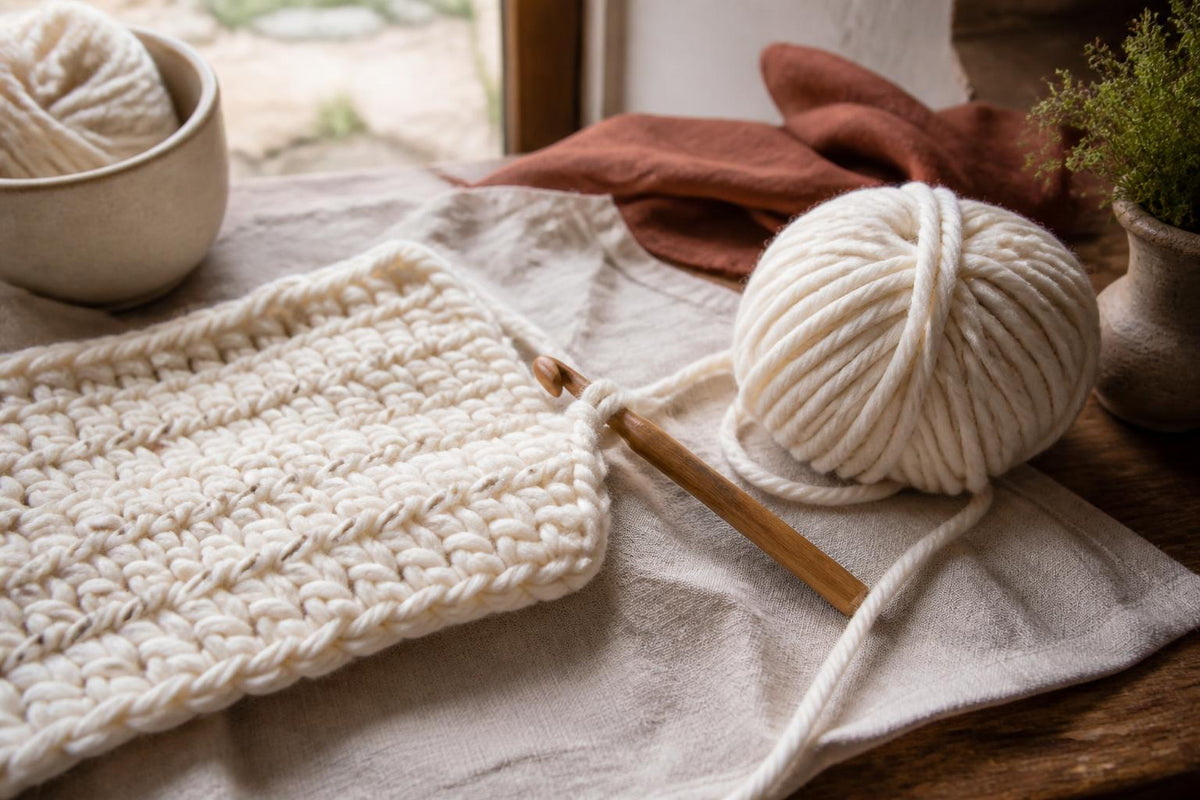
If you want to learn how to crochet for beginners, the easiest route is not to buy everything at once or start with an ambitious pattern. Begin with a smooth, light-coloured yarn, one hook in the size recommended on the ball band, and a very simple first project such as a dishcloth, scarf, or small blanket square. That combination makes the stitches easier to see, your tension easier to manage, and the whole process far less frustrating.
At Native Yarns, operated by Fleeta Limited, we find that most beginners do best when they understand three things before they start. First, the basic tools and the way yarn labels work. Second, the difference between UK crochet terms and US terms. Third, how to choose a first project that lets you practise the same few stitches repeatedly. Once those are in place, crochet becomes much easier to stick with.
What do you need to start crochet in the UK?
You need less than many beginners expect. A sensible starter list is:
- one crochet hook
- one ball or skein of yarn
- a pair of scissors
- a yarn needle for sewing in ends
- a few stitch markers, either purpose-made or simple locking markers
- a tape measure
- the pattern, if you are not simply practising swatches
If you are choosing tools for the first time, our guide on choosing a first crochet set you will actually use is a useful place to start.
In the UK, the first point of confusion is often terminology. Patterns written in UK crochet terms do not name stitches the same way as US patterns. A UK double crochet is not the same stitch as a US double crochet. If you buy a pattern, check whether it says UK or US terms before you begin. That one line at the top of a pattern can save a great deal of unpicking.
The most common terms you will meet in UK crochet terms are:
- chain, often written as ch
- slip stitch, ss
- double crochet, dc
- half treble, htr
- treble, tr
If you accidentally follow a US video while holding a UK pattern, your stitch height will be wrong almost immediately. Edges, measurements, and yarn use will all drift off course.
You will also see yarn weights described by category. In the UK, common categories include 4 ply, DK, aran, chunky, and super chunky. These are not exact guarantees of thickness, but they are a practical guide. A beginner can learn with several of them, but not all are equally forgiving.
Finally, read the yarn ball band before buying. It usually tells you:
- fibre content
- yarn weight
- recommended hook size
- metreage
- care instructions
- lot number or dye lot
- tension information
That label is the closest thing crochet has to a technical sheet. Keep it until the project is finished and blocked.
Which yarn and hook make learning easier?
For a first project, choose a yarn that helps you see what your hands are doing. That usually means a smooth yarn in a pale or mid-tone colour, with enough body that the stitches hold their shape clearly.
The easiest beginner yarns are often:
- smooth wool or wool blends
- smooth acrylic
- cotton with clear stitch definition
The harder beginner yarns are often:
- very dark shades, especially black or deep navy
- fluffy, brushed, or halo-heavy yarns
- novelty textures
- very slippery fibres
- yarns that split easily when the hook enters the stitch
Colour matters more than many people expect. Cream, soft grey, oatmeal, muted blue, and other lighter shades make loops easier to count. A dramatic dark shade can look beautiful, but it hides where the hook should go.
Thickness matters too. Very fine yarn can be fiddly because the stitches are small. Very thick yarn can be satisfying because progress is quick, but if it is too bulky for the pattern or too soft to show stitch structure, beginners can struggle to identify each loop. That is why many people start comfortably with DK, aran, or chunky yarns. Others enjoy immediate results with super chunky if the yarn has good definition.
Our own verified range includes World of Wool Chubbs, a super chunky merino yarn available in multiple colourways. For beginners who want to feel progress quickly, our super chunky merino yarn collection can be appealing, because larger stitches build fabric fast. The key is to choose a shade where the stitch shape remains easy to see and to accept that very thick yarn can magnify uneven tension while you are still learning.
As for hooks, follow the yarn label as your starting point. If the ball band recommends 6 mm, begin there. If your stitches become very tight and hard to work into, try going up a hook size. If your fabric looks loose and holey when the pattern should be denser, try going down a size.
Hook material affects comfort rather than correctness. Metal hooks glide quickly. Bamboo and wood can feel warmer and slightly grippier. Soft-handled hooks can reduce strain if your hands tire easily. There is no universal best choice, but there is a best choice for a relaxed grip, and that matters when you are practising.
How do the first crochet stitches work?
Crochet is built from loops. The hook draws one loop through another in a controlled sequence, and the order of those movements creates each stitch.
Most beginners start with these foundations:
- slip knot
- chain
- slip stitch
- double crochet in UK crochet terms
- treble in UK crochet terms
To begin, make a slip knot on the hook. Then work chains by catching the yarn with the hook and pulling it through the loop already on the hook. A row of chain stitches becomes the base for your first proper row.
The next step is learning where to place the hook. This is where beginners often hesitate. Each stitch has a top that usually looks like a small V. In basic rows, you will usually insert the hook under both loops of that V unless the pattern says otherwise.
Holding the hook does not need to look elegant. Some people hold it like a pencil, others like a knife. Both are normal. What matters is that your wrist stays fairly relaxed and that you can control the hook tip accurately.
For the yarn hand, aim to guide the yarn rather than grip it tightly. If the yarn is wound tightly around your fingers, your tension will often become too tight. If it hangs completely loose, the stitches may become inconsistent. A light, repeatable path over one or two fingers is enough.
Here is a simple view of the first working stitches in UK crochet terms:
Chain You yarn over and pull through the loop on the hook.
Slip stitch Insert the hook into the stitch, yarn over, and pull through the stitch and the loop on the hook in one movement.
Double crochet Insert the hook into the stitch, yarn over, pull up a loop, yarn over, pull through both loops on the hook.
Treble Yarn over first, insert the hook into the stitch, yarn over, pull up a loop, yarn over, pull through two loops, yarn over, pull through the final two loops.
Now the important comparison. In UK crochet terms:
- UK double crochet equals US single crochet
- UK half treble equals US half double crochet
- UK treble equals US double crochet
That difference is not a small regional spelling variation. It changes the structure of the fabric. Always confirm the pattern language before you start.
Why should beginners make a tension square?
A tension square is a small sample swatch worked in the stitch pattern, using the yarn and hook you intend to use for the project. Many beginners skip it because they want to get straight to the finished item. In some cases that is fine. In others, it creates more work later.
A tension square tells you:
- whether your stitches are larger or smaller than the pattern expects
- whether the fabric feels too stiff or too loose
- how the yarn behaves after handling
- whether you like the texture before committing to the full project
It matters most for projects where size is important, such as garments, hats, fitted accessories, and shaped items. If the pattern says your square should measure a certain size and yours does not, the finished piece may come out too large or too small.
It also helps with yarn quantities. If your stitches are tighter than the pattern designer’s, you may use less yarn but get a smaller item. If they are looser, you may use more yarn and risk running short. A tension square gives you early warning.
For a simple scarf or a practice cloth, exact tension matters less. For a jumper, cardigan, or wearable with sizing, it matters a great deal. In the UK, that practical distinction is the same as elsewhere, but yarn substitution can complicate things because ball sizes, metreage, and recommended gauges vary between brands.
Make the square a little larger than the measurement area the pattern asks for. Then measure the central section rather than the edges, which are often less even. If the pattern gives blocking instructions, follow them before measuring. Some fibres relax or bloom after washing, especially wool and merino.
What is a good first crochet project?
A good first project repeats a small number of stitches, has a simple shape, and does not punish minor irregularities. You want something that teaches rhythm, not something that demands advanced counting and shaping from the first row.
Strong first projects include:
- a dishcloth
- a simple scarf
- a blanket square
- a small lap blanket
- a basic cowl worked flat
- a straightforward basket or cosy in thick yarn
These projects let you practise chaining, turning, counting stitches, and keeping edges straight. They also make it easier to see improvement from row to row.
Projects that are often harder than they first appear include:
- fitted garments
- amigurumi with very tight tension
- lace
- complex granny constructions with multiple joins
- wearables that rely on exact sizing
- projects using several colour changes in every row
When choosing yarn quantity, start with the pattern requirement if you have one. If you are improvising a scarf or cloth, use the metreage on the ball band and compare it with similar beginner patterns. If you are making anything larger than a small practice piece, buy enough at the start.
That is where the dye lot matters. Yarn dyed in different batches can vary slightly in shade, even when the colour name is the same. Check that all balls for one project have the same dye lot if you want the colour to remain consistent across the whole piece. This is especially important for larger projects and plain fabrics where subtle changes show clearly.
Colour planning matters too. If you want help building combinations, our yarn colour palette inspiration page can help you think about contrast, tone, and how different shades sit together before you begin.
If you want the satisfaction of finishing quickly, choose a project small enough to complete in a weekend or a few evenings. Our round-up of fast crochet projects you can finish this weekend can help you pick something realistic for your current skill level.
What mistakes slow beginners down most?
The first common problem is missed stitches. Beginners often lose the first or last stitch of a row, which makes the fabric gradually narrow. The practical fix is to count stitches at the end of every row and place a stitch marker in the first and last stitch until your eye learns to recognise them.
The second is tension that is far too tight. Tight stitches are hard to insert the hook into, and they make crochet feel like a struggle. If this is happening, relax your yarn hand, make your starting chain with a larger hook if necessary, and focus on keeping the loops on the hook large enough to move freely.
The third is pattern confusion caused by term mismatch. A pattern in UK crochet terms worked as if it were in US terms will go wrong immediately. Before the first stitch, identify the pattern language and write the equivalent terms in the margin if needed.
The fourth is uneven edges. This usually comes from missing turning chains, adding extra stitches at the row ends, or mistaking the turning chain for a stitch when the pattern says not to. Read the row instructions carefully and compare your stitch count with the pattern after each row.
The fifth is using the wrong yarn for the learning stage. A fuzzy or very dark yarn can make even basic stitches hard to read. If you feel lost, switch to a smoother, lighter yarn and try the same practice again. It is not cheating. It is choosing better visibility.
The sixth is not checking the ball band. Hook size, care instructions, and fibre content all matter. A washable cotton cloth and a soft merino scarf are not interchangeable projects. If you are learning with World of Wool Chubbs, remember that a super chunky merino yarn behaves differently from a finer, firmer cotton or acrylic. It will grow quickly, feel soft in the hand, and may need a project that suits its bulk.
The seventh is pulling from the skein awkwardly and letting the yarn tangle. Keep the yarn in a clean bag or basket so it feeds smoothly. Good handling reduces interruptions and helps you maintain rhythm.
Finally, beginners often compare their first rows to polished sample photos too soon. The first few rows may look uneven. That is normal. Crochet improves through repetition. If the stitch count is correct and you can identify each stitch, you are making progress.
Learning to crochet as a beginner is easier when the first project is chosen with care. A clear yarn, the right hook, a simple pattern, and a basic understanding of UK crochet terms will do more for your confidence than a basket full of supplies. Start with stitches you can see, make a tension square when size matters, check your dye lot before larger projects, and let your first project teach you the rhythm of the craft. That steady start is usually what turns crochet from a brief experiment into a skill you genuinely enjoy.
Is crochet or knitting easier for a complete beginner?
Many beginners find crochet easier to correct because you usually work with one live stitch at a time. That said, the easier craft is often the one whose rhythm and projects appeal to you most.
What is the best yarn for a first crochet project?
Choose a smooth, light-coloured yarn that lets you see each stitch clearly. Avoid very dark shades, novelty textures and highly splitty yarns until you can recognise stitch structure more confidently.
Do I need to follow UK crochet terms?
If you are using a UK pattern, yes. UK crochet terms and US terms are not interchangeable, and the same stitch name can mean different things. Always check which system a pattern uses before you begin.
Should a beginner buy lots of hooks straight away?
No. One or two sensible sizes are enough to start. It is more useful to learn how hook size changes fabric and tension than to buy a full set before you know what kinds of projects you enjoy.
When does dye lot matter?
dye lot matters most when you need more than one ball for the same visible project. Small colour differences can show between batches, so it is worth checking labels before you begin.