
T-shirt yarn for crochet without wasted metres
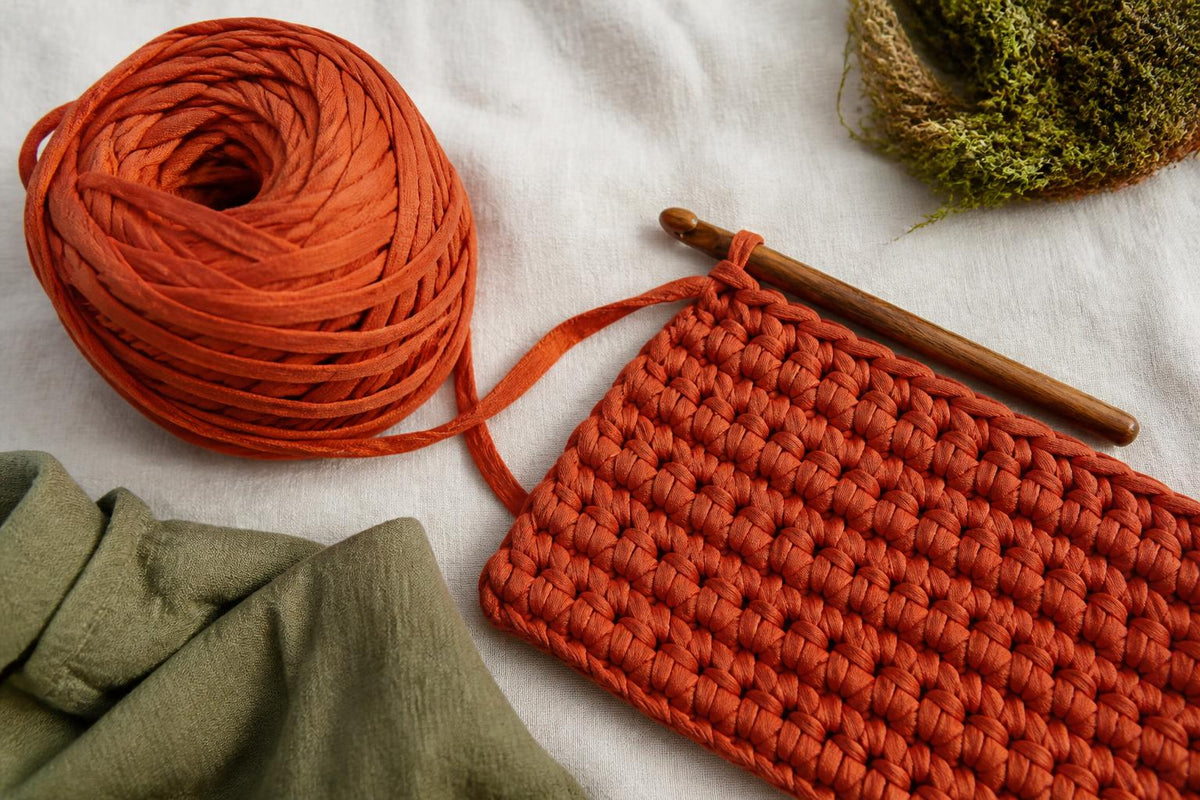
If you want to crochet with T-shirt yarn without ending up with half a ball left over or, worse, running short near the end, the key is to judge the yarn properly before you start. T-shirt yarn varies far more than many beginners expect. Width, stretch, fibre mix and joins all affect how many usable metres you actually get, how firm the fabric feels, and whether your basket, bag or rug keeps its shape.
For most projects, we suggest treating T-shirt yarn as a structural material rather than a general-purpose yarn. It can be excellent for sturdy homewares and accessories, but it rewards a bit of planning. A proper sample, a realistic metre estimate and a close look at the yarn itself will save far more waste than guessing by eye.
What T-shirt yarn is and when it works well
T-shirt yarn is usually made from jersey fabric cut into strips and wound into cakes or balls. In many cases it comes from textile offcuts from garment production, though some ranges are purpose-made rather than reclaimed. That matters because reclaimed yarn can vary more from one batch to another, even within the same colour family.
What you feel in the hand is not just “chunky cotton”. Most T-shirt yarn is a knitted fabric strip, often cotton-rich but sometimes blended with elastane, polyester or viscose. The strip may be flat, tubular or slightly folded in on itself. That construction gives it weight, bounce and stretch, but also means it behaves differently from spun yarn.
Used well, T-shirt yarn is excellent for:
- storage baskets
- tote bags
- mats and rugs
- plant pot covers
- slippers and home accessories
- simple pet beds
- sturdy bases for organisers
It is less suitable for projects that need drape, fine stitch definition or lightness. Garments can become heavy very quickly, especially if worked densely. Blankets are possible, but they can be weighty and awkward to wash and dry in a domestic machine.
The main strengths of crochet T-shirt yarn are structure and speed. Because it is thick, projects grow quickly. Because it has body, it can hold shape without much help. If you want a basket that stands up, or a bag that feels substantial, it can do that better than many standard yarns.
Its limitations are just as important. Stretch can distort the finished piece. Weight can pull handles longer over time. Bulk can make seams lumpy. If the strip width is inconsistent, your stitch size may fluctuate even when your technique is sound.
If you are still deciding whether this is the right material at all, it helps to compare it with other sturdy options. Our guide to chunky yarn for crochet that holds its shape explains what gives a yarn firmness and when a different construction may suit the project better.
How to choose the right yarn before you buy
The most useful habit is to stop looking only at the ball size. Two cakes that look similar can contain very different usable lengths.
Start with fibre content. Cotton-rich T-shirt yarn tends to feel cooler, heavier and less springy. Blends with elastane stretch more and may recover better, but too much stretch can make sizing harder. Polyester blends can be lighter and sometimes more slippery. If the label simply says recycled textile yarn, expect greater variation and inspect the product description closely.
Then look for width consistency. A good quality T-shirt yarn should be fairly even across the length. Small variation is normal, especially in recycled fabric yarn, but dramatic changes from narrow to wide strips will show in the fabric. For baskets and bags, consistency matters because uneven strips create weak spots and waviness.
Stretch is the next point. Pull a short section gently. Does it lengthen easily? Does it spring back? A little give can make crocheting easier on the hands, but an overly elastic yarn can lead to a floppy result unless you size down your hook and work tightly.
Check the joins. Most T-shirt yarn has joins somewhere, but they should be manageable. A neat sewn join is easier to hide than a thick knot. If you are making a visible item such as a minimalist bag, too many bulky joins can spoil the finish. When the yarn is sold online, look for close product photos and plain wording about recycled or continuous-strip construction.
Colour also deserves more attention than many people give it. Solid deep shades can disguise stitch irregularities, while pale or marl shades may show every join and tension change. If you are combining more than one ball for a single project, check the dye lot. With recycled fabric yarn, the issue is sometimes not a formal dye lot in the usual sense but batch variation in the source fabric. Either way, buying all you need at once is the safest approach.
This is one area where UK and wider EU practice can differ in emphasis. In the UK, online yarn shops usually state fibre content, weight and metreage clearly where that information is available. In the EU generally, textile fibre labelling rules are harmonised, but recycled fabric yarn may still reach the customer with less standardised presentation than a conventional spun yarn. That means you may need to rely more on product-specific notes and seller photography than on a familiar yarn-category label alone.
Also check metreage against weight. A heavier ball is not automatically better value if much of the bulk comes from a thick, dense strip. For crochet, metres are usually the more useful comparison than grams.
If you are choosing between T-shirt yarn and a non-fabric alternative for a shaped project, it can help to compare how different materials behave structurally. We cover that in our article on choosing cotton yarn for crochet in the UK, especially for readers balancing softness against firmness.
Which hook size to use and why tension matters
T-shirt yarn labels often suggest a broad hook range, and that is sensible because the right size depends on the project. The same yarn might work with a larger hook for a flexible mat and a smaller one for a firm basket.
As a starting point, many T-shirt yarns suit hooks somewhere around 8 mm to 12 mm, but the label is only a starting point. For a structured item, go smaller within the recommended range. For drape and speed, go larger.
Hook size changes three things at once:
- the size of each stitch
- the density of the fabric
- the strain on your hands
A larger hook gives a looser fabric, uses fewer stitches over the same area and can reduce hand fatigue. A smaller hook gives a tighter fabric and better shape retention, but may make the work harder physically.
That is why a tension square matters so much. With ordinary yarn, many crocheters skip it for simple accessories. With T-shirt yarn, we would not. Make a proper sample in the stitch pattern you plan to use, at least 10 cm square if possible. Measure it after the fabric has rested. If the project will carry weight, such as a tote bag, hang the sample briefly or handle it firmly to see whether it grows.
In UK crochet terms, double crochet creates a denser fabric than treble crochet and is often the better choice for baskets and bags. Readers using US patterns should note the term difference. UK double crochet equals US single crochet, and UK treble equals US double crochet. If you switch between pattern sources, check the stitch names before you start. Misreading the terms with T-shirt yarn can change the finished size dramatically because each stitch is so large.
Your tension square should answer practical questions, not just stitch counts. Ask:
- Does the fabric stand up by itself?
- Can you see gaps that will matter in use?
- Does the piece curl?
- Does it feel too stiff to work comfortably?
- How many stitches and rows give 10 cm?
Once you know stitches and rows per 10 cm, estimating quantity becomes far more reliable. If you are new to sampling or still building confidence with tools, our piece on how to choose a first crochet set that you’ll use may help you sort out which hook sizes and basics are genuinely useful.
How much T-shirt yarn a crochet project needs
The cleanest way to avoid wasted metres is to estimate from your own sample, not from a generic pattern for “chunky yarn”.
Here is the practical method we use.
First, make your tension square in the actual stitch and hook size you intend to use.
Second, measure the sample accurately. Count stitches and rows over 10 cm.
Third, weigh the sample if you can. If you have kitchen scales that measure in grams, this is very useful. You then compare the sample weight to the total ball weight and metreage on the label. If the label gives both grams and metres, you can estimate metres used by the sample.
For example, if a ball weighs 700 g and contains 100 m, then 70 g is roughly 10 m. If your sample weighs 35 g, it has used about 5 m. From there, calculate how many sample-sized areas your project contains.
For flat items, estimate area first. A mat measuring 60 cm by 40 cm contains twenty-four 10 cm squares. If one 10 cm square uses 5 m, you need about 120 m, then add extra for edges, joining in a new ball and a margin for error.
For baskets, work by surface area plus structure. A round basket with a base and sides needs yarn for:
- the circular base
- the side walls
- any folded rim
- handles or reinforced sections
The base often uses more yarn than beginners expect because increasing rounds add stitches quickly. Handles also take more yarn than they appear to, especially if you reinforce them with additional rounds or slip stitch edging.
For bags, allow for stretch and reinforcement. A simple tote may look like two rectangles, but if you add a base panel, straps, edging and a closure, the metreage rises fast. If the bag needs to carry weight, plan for tighter stitches and therefore more yarn.
As a rough working principle, buy by metres with a buffer. For small home accessories, an extra 10 to 15 per cent is sensible. For fitted sets, large baskets or projects where matching colour matters, more buffer is often worth it. That is particularly true if the yarn is recycled or subject to visible batch variation. Running out and trying to match later is where waste usually begins.
Do not forget the hidden extras:
- test swatches
- mistakes and reworking
- handles
- bases
- borders
- seams or joins
- lids for baskets
- inner support rounds
If you are making your own pattern, write the estimate down before you begin. Note the ball metreage, your sample result and the planned dimensions. That one page of notes is often the difference between a tidy finish and a half-made project.
Common problems when crocheting with T-shirt yarn
The most common complaint is sore hands. T-shirt yarn is heavy and often worked on a relatively small hook for its thickness, so the resistance can be high. Take shorter sessions, relax your grip and avoid pulling every stitch tight. If the project needs firmness, get that from hook choice and consistent tension, not from force.
Twisting is another frequent issue. Fabric strip yarn can kink as you work, especially if the strip is not fully tubular. Let the ball unwind freely. Every so often, drop the work and allow the yarn to untwist. If the twist is severe, rewind the ball more loosely.
Uneven stitches usually come from inconsistent strip width, fluctuating tension, or both. If the yarn itself varies, some unevenness is unavoidable. In that case, choose a simple stitch pattern and a project where texture is acceptable. Dense decorative stitch patterns often look muddled in T-shirt yarn.
Bulky seams can spoil an otherwise neat finish. Where possible, crochet pieces together rather than sewing thick edges with more of the same yarn. If you do seam, consider using a flatter joining method or a finer strong yarn in a matching shade for less bulk.
Curling usually points to one of two things. Either the base is too tight, often from a hook that is too small, or the increase rate is off, especially in circles. If a circular base curls upward before you want it to, check both the pattern maths and the fabric density.
Projects growing after use are often the result of stretch under load. Bags are the main culprit. The fix is prevention. Use tighter stitches, shorter straps, or reinforced handles. For storage baskets, growth can happen if the sides are worked too loosely. A firm base and dense side walls help the shape last better.
If you are a newer crocheter, choosing the right project matters as much as choosing the right yarn. Our guide to crochet projects that help beginners finish their first make is useful if you want something satisfying without wrestling a large, heavy piece from the outset.
Care, storage and sensible alternatives
Finished T-shirt yarn items need practical care. Always check the fibre content first. A cotton-rich item may tolerate gentle machine washing, but a mixed recycled textile yarn may not behave predictably, especially if it includes elastane or unstable dyes.
In the UK, follow the care instructions supplied with the yarn wherever they are available. If there is no clear care label, we suggest spot-cleaning structured items first and testing any full wash cautiously. Use cool or lukewarm water, mild detergent and minimal agitation. Avoid high heat. Heat can distort stretch fibres, shrink cotton components and alter the shape you worked hard to achieve.
Dry flat and reshape while damp. Hanging a wet T-shirt yarn basket or bag can pull it out of line. For rugs and mats, make sure they are thoroughly dry before use or storage, as dense fabric can hold moisture longer than expected.
For storage, keep finished pieces clean, dry and supported. Do not crush baskets under heavy loads for long periods if you want them to hold a crisp shape. Store unused yarn away from direct light and damp. Because reclaimed fabric yarn can vary by batch, keep the label or order note with any leftovers so you know what you used if you return to the project later.
Sometimes the sensible choice is not T-shirt yarn at all. If you want a thick yarn for a quick project but need more softness, better stitch definition or less weight, a spun wool can be easier to handle. For educational comparison, a super chunky merino such as World of Wool Chubbs behaves very differently. It has loft rather than flat fabric density, so it suits cosy accessories and softer structure rather than rigid baskets. Native Yarns is operated by Fleeta Limited, and where we discuss alternatives, we do so to help you choose the right material for the job, not to force every project into the same yarn category.
That comparison matters because “thick” does not mean “interchangeable”. T-shirt yarn gives firmness through fabric strip construction. Chubbs from World of Wool gives bulk through spun merino fibre. Both are substantial, but they solve different problems.
If your goal is a basket that stands, T-shirt yarn may be the better tool. If your goal is warmth, softness and a lighter feel in the hand, a super chunky spun yarn may be more practical. Choosing well at the start is what prevents wasted metres, wasted effort and projects that never quite become what you hoped.
Is T-shirt yarn good for beginners?
It can be, especially for simple baskets and mats, because stitches are easy to see. The trade-off is weight and hand strain, so shorter sessions and a comfortable hook help.
What hook size is best for crochet T-shirt yarn?
There is no single best size. Many makers start around the larger end of standard crochet hooks, then adjust after a tension square to get the firmness or drape they want.
Why does my T-shirt yarn project come out bigger than expected?
Stretch is the usual reason. T-shirt yarn can relax after stitching or with use, so a tension square and measured resting time before final calculations are important.
Can I mix T-shirt yarn with other yarns?
Yes, but only if the structure suits the project. Mixing very heavy ribbon-like yarn with lighter yarns can distort shape, edges and tension unless used deliberately for detail.
Do I need to match the dye lot?
If the yarn is dyed and the project uses more than one ball or cone, matching dye lot is the safest choice. Colour variation can show clearly in large crochet panels.