
How to match hooks and yarn without wasting wool
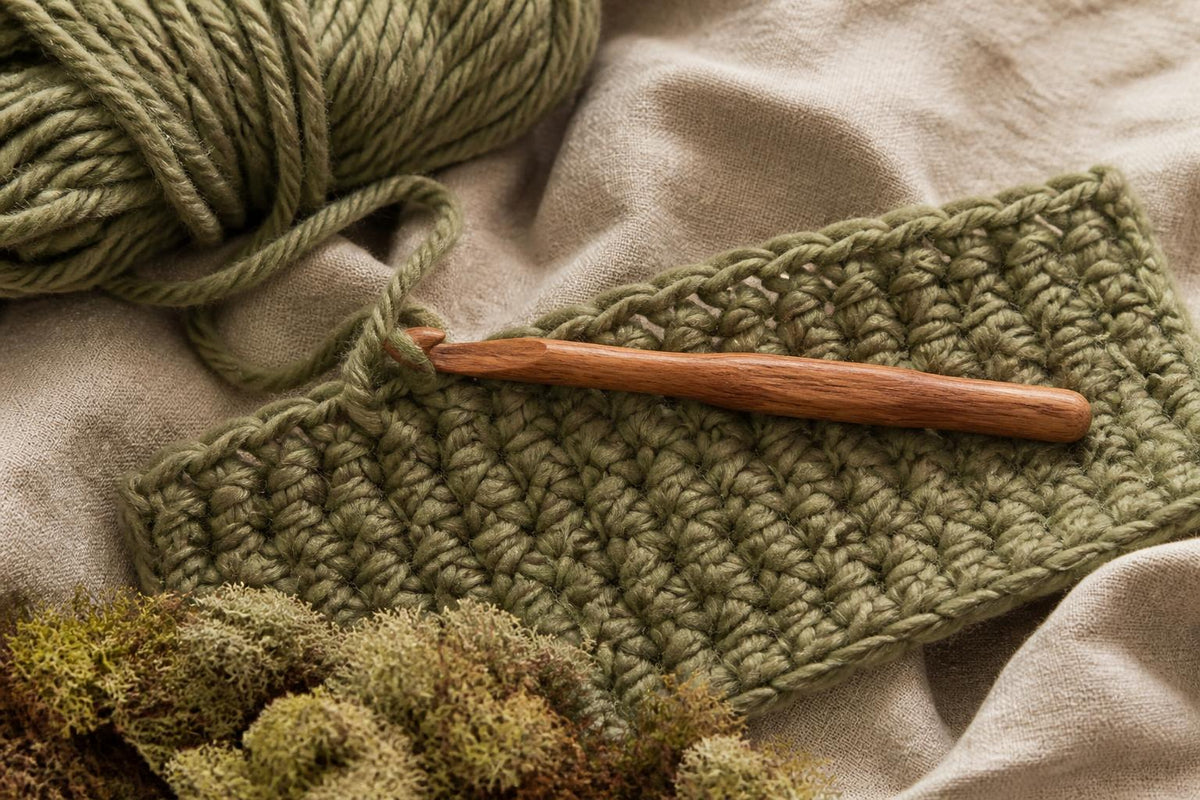
Matching your hook to your yarn is one of the simplest ways to make crochet feel easier and to stop wasting wool. When the pairing is right, stitches sit evenly, the fabric behaves as you expect, and you are far less likely to frog half a project because it has turned out stiff, floppy, oversized or short of yarn. When the pairing is wrong, even good technique can produce disappointing results.
A sensible match starts with the yarn band, but it does not end there. We choose a hook size by looking at the fibre, the yarn structure, the type of project, and the finish we want. That matters whether we are making a fitted garment, a hard-wearing basket, or a quick blanket from super chunky merino. If you are still building confidence, our guide to crochet for beginners with the right first project is a useful companion to the practical steps below.
What a good hook and yarn match actually changes
The match between hook and yarn changes more than appearance. It affects the size of every stitch, which then affects the size of the whole piece. If your hook is too large for the yarn, loops open out, rows grow taller, and the finished item can come out larger than planned. If your hook is too small, stitches tighten, shorten, and pull the fabric in.
Drape is usually the next thing people notice. A larger hook, used within reason, gives the yarn more room and creates a softer fabric that bends and folds more easily. That suits shawls, scarves, garments and some blankets. A smaller hook creates a firmer fabric with more structure, which is often better for bags, baskets, slippers and anything that needs to hold shape.
Warmth changes too. Looser stitches trap air differently from dense stitches. An open fabric can still be warm if the fibre is lofty, but it will usually let more air through. A tighter fabric reduces gaps and often feels warmer and more substantial in use. That can be useful for winter accessories, though too-tight crochet can become heavy and board-like rather than cosy.
Durability is tied to both fibre and tension. If stitches are too loose, they can snag more easily and lose shape faster. If they are too tight, the yarn is under more friction during making and wear, and the fabric may feel stressed at seam points or corners. For items that will be handled a lot, such as cushions, pet blankets or children’s accessories, a balanced fabric usually lasts better than either extreme.
Your speed changes with the pairing as well. Most of us work fastest when the hook glides cleanly through the yarn and the loops are easy to draw up. Too small a hook can make every stitch a struggle. Too large a hook can feel awkward and reduce control, especially for newer crocheters.
Then there is yarn consumption. This is where wasted wool often creeps in. Tight crochet generally uses more yarn because each stitch is compact and more stitches are needed to cover the same area. Looser crochet may use less yarn for the same dimensions, but if it creates a fabric you do not actually want, any apparent saving disappears. The real goal is not the fewest grams, it is the right fabric first time.
How to choose a hook from the yarn label and the project
The yarn band is our starting point. Most yarn labels give a recommended hook size or a range. Take that as guidance, not law. Manufacturers are giving a sensible general recommendation, but they do not know whether you are making a dense storage basket or a drapey cowl.
Start by checking three things on the label. First, the recommended hook size in millimetres. Secondly, the yarn weight category, such as 4 ply, DK, aran, chunky or super chunky. Thirdly, the tension information, if given, although tension on labels is often aimed more at knitting than crochet.
For crochet, we usually choose a starting point like this:
- Lace or very fine yarn, begin around 1.5 mm to 2.5 mm
- 4 ply, begin around 2.5 mm to 3.5 mm
- DK, begin around 4 mm
- aran, begin around 5 mm
- chunky, begin around 6 mm to 7 mm
- super chunky, begin around 8 mm to 12 mm, depending on structure and project
These are practical starting points, not fixed rules.
The project type matters just as much. For a garment or shawl, we often start in the middle or upper end of the recommended range because we want movement and comfort. For amigurumi, we usually go smaller than the label suggests so the stuffing does not show through. For baskets and mats, we may also go down a size to create firmness. For blankets, we look for a fabric that feels pleasant in the hand and does not leave large, cold gaps unless an openwork design is deliberate.
If you use UK crochet terms, keep stitch naming clear when following a pattern or adapting one. In UK crochet terms, double crochet is a compact stitch. In US terms, that same stitch name means something taller and looser. This matters because hook choice is tied to stitch height. A pattern written in UK crochet terms may naturally produce a denser fabric than a similar-looking US pattern, even before you alter the hook size.
As a practical example, if a super chunky yarn label suggests 10 mm to 12 mm, we might begin with 10 mm for a cushion cover, 12 mm for a soft throw, and perhaps 9 mm or 10 mm for a basket if the yarn structure can handle it. If the yarn is lofty and lightly spun, too small a hook may drag and felt the surface. If the yarn is smooth and firm, dropping a size may work well.
If you are still choosing tools, our guide on how to choose a first crochet set that you’ll use explains what is worth having from the start.
Why fibre and yarn structure matter as much as weight
Yarn weight tells us thickness, but it does not tell us everything about behaviour. Two yarns labelled chunky can act very differently if one is tightly plied cotton and the other is airy merino roving style yarn. This is why a hook that works beautifully with one yarn can be frustrating with another of the same nominal weight.
Merino is usually soft, springy and elastic. That elasticity helps stitches recover and can make crochet feel forgiving. With a slightly larger hook, merino often produces a plush, comfortable fabric with good loft. With a smaller hook, it can become dense and very warm, but still softer than many plant fibres. The caution with some merino yarns, especially lofty singles or softly twisted constructions, is abrasion. If the hook is too small or has a rough point, it can catch fibres and rough up the surface.
Cotton behaves differently. It has less elasticity, more weight, and often sharper stitch definition. A cotton fabric can look beautifully crisp, especially in textured patterns. But because it does not spring back in the same way, many crocheters prefer not to go too small with the hook unless structure is the aim. Too tight a cotton fabric can feel hard on the hands and tiring to work. If you are comparing fibres for a practical project, our article on choosing cotton yarn for crochet in the UK covers where cotton is especially useful.
Acrylic varies widely. Some acrylic yarns are smooth and resilient, others squeak on the hook or split more than expected. It often works well across a broad range of hook sizes, which is one reason beginners meet it early. Blends, such as wool-acrylic or cotton-acrylic, often combine the strengths and weaknesses of both fibres.
Yarn structure matters alongside fibre. Consider these common differences:
- Tightly plied yarns usually give clear stitch definition and resist splitting.
- Loosely spun yarns can feel soft and lofty but may shed, flatten or pill more readily.
- Chainette and blown constructions can be light for their size, so a hook that seems large on paper may be exactly right in practice.
- Smooth yarns show every stitch. Fuzzy yarns hide uneven tension but can make counting harder.
- Multi-ply yarns often tolerate frogging better than delicate single-ply yarns.
Split risk is especially relevant for crochet because the hook enters the stitch directly. Cotton, bamboo blends and some loosely twisted wool yarns can split if the hook tip is too sharp or if the crocheter works quickly. A rounded hook head can help, but so can moving up a size if the fabric allows it.
Stitch definition is where hook choice can transform the result. Cables, post stitches and textured motifs often look best when the yarn has enough structure to hold edges. A very fluffy fibre with a large hook may feel lovely but blur the pattern. For plain blankets or scarves that softness may be exactly what we want.
How to use a tension square before committing to a project
A tension square is the most reliable way to judge whether your chosen hook and yarn belong together for a specific pattern. It takes a little time, but much less than remaking a project that grew by ten centimetres or ran out of yarn three quarters of the way through.
For crochet, we recommend a square at least 12 cm by 12 cm, and often closer to 15 cm by 15 cm for chunky and super chunky yarns. Cast on, or chain, more stitches than the pattern gauge area requires. If a pattern gives tension over 10 cm, do not make only 10 cm. Edge stitches distort the measurement.
Use the actual stitch pattern from the project if possible. If the project is mostly treble crochet in UK crochet terms, swatch in that. If it uses a textured repeat, include the repeat. A square in plain stitches tells us less than a square in the real fabric.
Then follow this method:
- Make the square with your chosen hook, keeping your usual working style.
- Finish it neatly and leave a decent border around the measured area.
- If the yarn is wool or a wool blend, treat the square as you plan to treat the finished item. That may mean a light wash, a soak, or simply resting it flat to settle. Always follow the care guidance on the yarn band.
- Let it dry fully, flat and unpinned unless the pattern specifically requires blocking.
- Measure the central 10 cm area with a rigid ruler or gauge tool.
- Count stitches across and rows down within that area.
Now judge both numbers and fabric feel. If you have too many stitches in 10 cm, your stitches are too small, so go up a hook size. If you have too few stitches, go down a hook size. Change one size at a time in metric terms, often by 0.5 mm for finer yarns and 1 mm for chunkier yarns.
But do not chase numbers blindly. If you hit the exact stitch count and hate the fabric, that is not success. For garments and fitted items, gauge is critical. For blankets and scarves, fabric quality may matter more than exact dimensions. If the pattern is flexible and the feel is right, you may choose to continue with a small size variation and adjust your yarn quantity accordingly.
Change yarn choice, not just hook size, if the square shows deeper problems. If the stitches split constantly, if the fabric twists badly, if the yarn pills after one wash, or if the drape is completely wrong for the item, another hook may not solve it.
Planning quantities, colour and dye lot before you buy
Buying enough yarn at the start is one of the simplest ways to avoid waste. Returning later for one more ball can be awkward if the shade has shifted or the line has changed. This matters with all yarn, but especially with super chunky projects, where each extra row uses a noticeable amount.
Begin with the pattern quantity if you have one, then allow for your own tension. If your crochet tends to run tight, you may need more yarn than the pattern states. If you are substituting yarn, compare not just ball count but total metreage. Five balls of one yarn may contain far less yarn than five balls of another.
For blankets, oversized scarves and cushions, sketch the finished dimensions and check whether the yarn gives enough coverage for the weight you plan to buy. For freehand projects, making a measured sample and weighing it can help estimate needs if you have scales at home. If not, the safest course is to round up rather than down, particularly when the project relies on one uninterrupted colour.
Always check the dye lot. A dye lot identifies a batch dyed together. Even when the colour name is the same, batches can vary slightly. In crochet those shifts can show as visible bands, especially in large plain areas. Buy enough from the same dye lot where possible. If you must combine lots, alternate balls every row or every two rows to blend the transition.
Colour deserves more thought than many people give it. Dark shades can hide stitch definition and make counting harder, which is not ideal for a first project. Very pale shades show texture beautifully but may show marks more readily in heavy-use items. Mottled or heathered yarn can be forgiving of uneven stitches. Highly variegated yarn can overpower textured patterns.
For super chunky work, colour and quantity both become more immediate because the yarn is visually bold and projects grow fast. A dramatic shade can look wonderful in a simple blanket, but in a heavily textured basket it may obscure the detail. Likewise, because super chunky yarn covers ground quickly, it is easy to underestimate how much a large throw or floor cushion will need. We would rather have one ball left for a matching accessory than come up short with a discontinued shade.
Where Native Yarns fits if you are choosing for a first chunky make
At Native Yarns, operated by Fleeta Limited, our verified retail range is centred on World of Wool Chubbs, a super chunky merino yarn available in multiple colourways through our online shop. For a first chunky make, that focus is useful because it narrows the decision down to a yarn type that is straightforward to understand and satisfying to work up quickly.
Chubbs sits in the category many beginners reach for when they want visible progress and a softer hand than some structured plant-fibre yarns. Because it is merino and super chunky, it can suit simple scarves, cowls, lap blankets and other projects where warmth, loft and speed matter more than razor-sharp stitch definition. It is also the sort of yarn where making a tension square is still worth doing, even though the project may feel forgiving. A one-size hook change in super chunky yarn can alter the fabric quite noticeably.
We are careful not to imply a broader live stock range than we actually hold. We discuss other fibres, weights and tools in our journal because they help readers make better decisions, but our current verified yarn range is World of Wool Chubbs. If you are comparing options for shape and structure before committing, our piece on how to choose chunky yarn for crochet that holds its shape will help you judge whether a soft lofty yarn is the right fit for your project.
For a first chunky make, keep the pattern simple and let the yarn do the work. Choose a comfortable metric hook within the label guidance, make a proper tension square, and buy enough of the same dye lot to finish without stress. That is the combination that saves the most wool in practice, not a complicated formula, just good matching, tested before you commit.
Should I always use the hook size on the yarn label?
No. It is a starting point, not a rule. Your stitch style, the project and the fabric you want all matter, so make a tension square before deciding.
What happens if my hook is too small for the yarn?
The fabric usually becomes dense and stiff, stitches can be harder to work, and you may use more yarn than expected. It can suit baskets, but not every project.
What happens if my hook is too large for the yarn?
You will usually get a looser fabric with more drape and larger holes. That can work well for shawls or airy textures, but it may reduce structure and warmth.
Is super chunky easier for beginners?
Often, yes. Larger stitches are easier to see and count. A super chunky yarn such as World of Wool Chubbs can make early practice more readable and quicker to grow.
Why does dye lot matter in crochet?
Different dye lot batches can vary slightly in shade, even within the same colour name. Buying enough for one project at the start helps avoid visible changes later.